


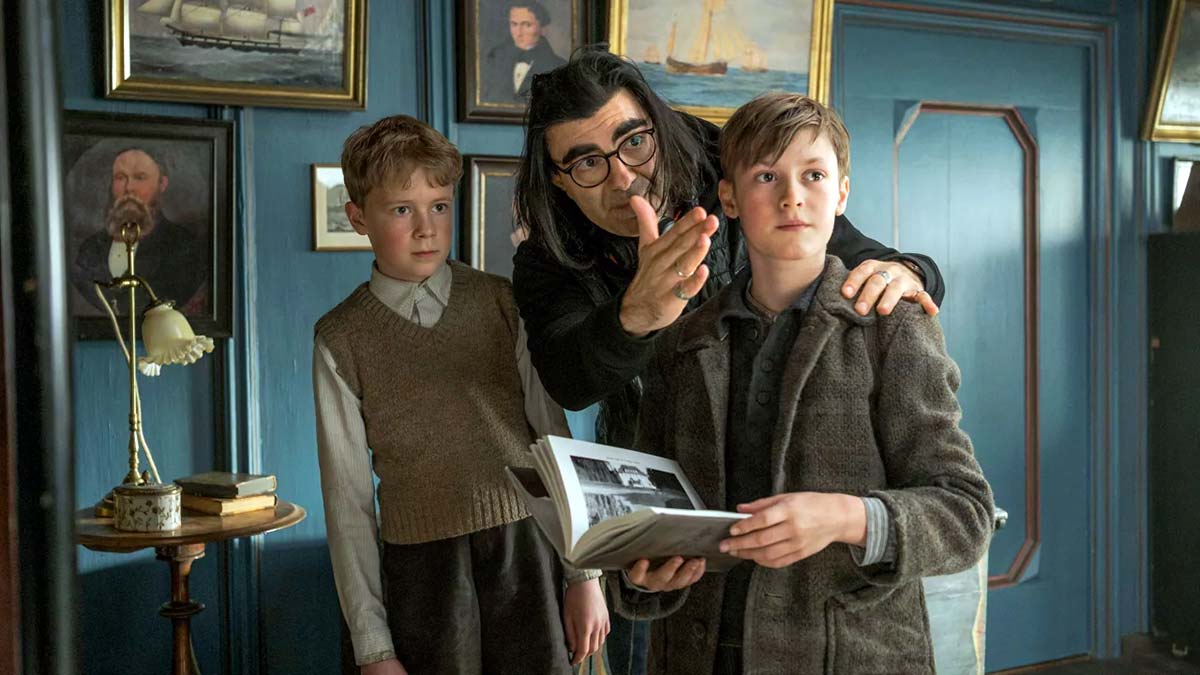
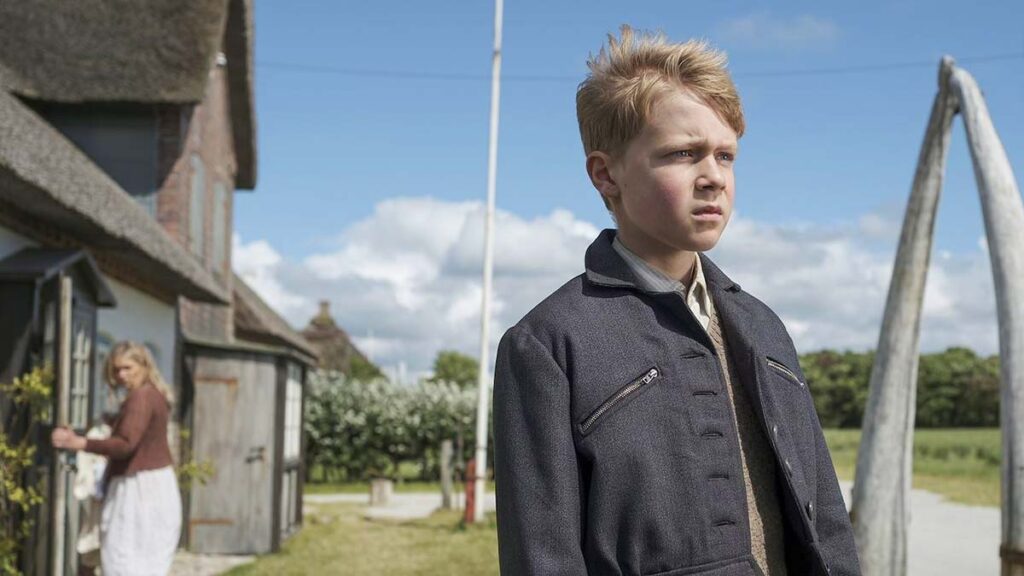
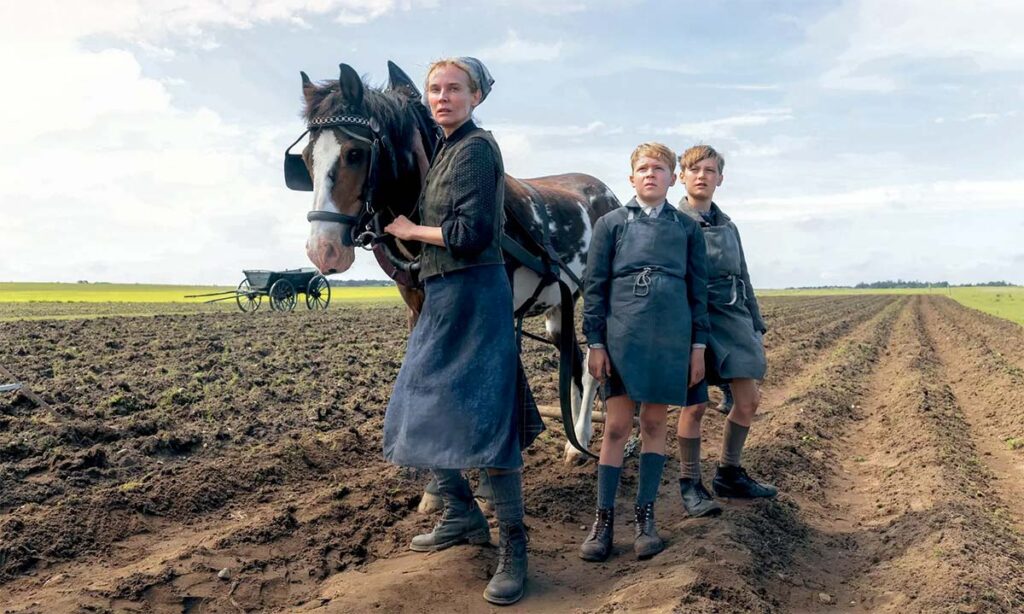
Eight years after “In the Fade” premiered in competition, Turkish-German filmmaker Fatih Akin (“Head On,” “The Edge Of Heaven”) returned to Cannes last year with the drama “Amrum.” A spare, aching coming-of-age drama set on a North Sea island in the final days of World War II, the film follows a 12-year-old boy as the war ends around him and buried family truths rise to the surface (read our review).
The project also arrived unusually—an adoption, essentially. The screenplay came from German actor and filmmaker Hark Bohm (Rainer Werner Fassbinder’s “Berlin Alexanderplatz”), Akin’s former film teacher, friend, and longtime collaborator, who had meant to direct the film himself before illness forced him to step away. What began as an act of support gradually became something deeper for Akin—a way of honoring a mentor, but also a path into questions of family, ideology, and the uneasy inheritance of history.
READ MORE: ‘Amrum’ Review: Fatih Akin Finds The Slow, Wounding End Of Innocence
That tension sat at the center of “Amrum,” which asks the audience to see the story through the eyes of an innocent boy born to Nazi parents—if not to empathize, then at least to understand how a child can love the people shaping him. But Akin did not approach the film as an exercise in softening Nazism or sanding down the past. He approached it as a story about the contradictions children inherit from adults and about how love, guilt, and ideology can coexist in the same household without canceling one another out.
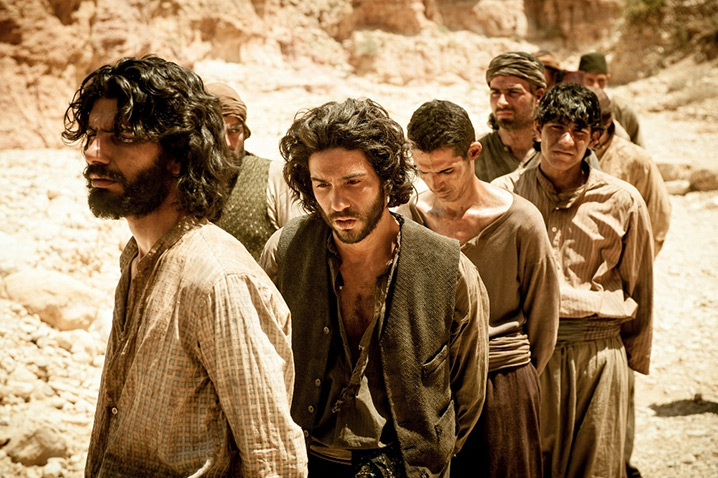
The film also opened onto larger questions Akin has wrestled with across his career—identity, history, violence, and the limits of belonging. That ran through the conversation just as strongly as the making of the film itself, especially when he turned to Germany, his family, and the bruising lessons of earlier work like the polarizing 2014 “The Cut,” a drama about the Armenian genocide that played out almost like a silent film and was pilloried by critics at the time.
In this Playlist interview, Akin discussed inheriting Bohm’s final script, the personal bridge he eventually found into “Amrum,” the fallout of “The Cut,” and why he now feels an urgency to make the films that matter most to him.
“Amrum” was an adoption, right? How did that work?
It was the first time I did such a stunt. It was the project of my former film teacher and friend, Hark Bohm, who passed away last December. It was supposed to be his last film. He wanted to produce it, and because I had this tiny company, I financed the writing process.
But then he got ill. He was old, actually. And then I couldn’t get insurance for him. You need film insurance when you shoot. I wanted him to make the film, and I wanted to stand next to him and bring him orange juice in the morning, whatever. But he got another stroke, and then there was a key moment where he asked me if I would direct the film. He wanted me to direct the film.
I heard myself saying yes. I didn’t know why I said that, because I felt very foreign to the material. I knew the material, and I did some rewriting for him because I’m a faster writer than he is. But this was very personal material for him. That was his biography, in a way. I, from a completely different generation, raised in a completely different way, accepted that. And toward the end of the editing process, I understood what the personal bridge was between me and the material. It was a very interesting quest.
What was that bridge for you?
First of all, it was about the love of cinema as a medium. There is the material, of course, but there is also the behind-the-scenes story. Then there is also just this feeling of, ‘Hey man, I love filmmaking. I love everything to do with films.’ If I couldn’t do films, I would restore films by other people. I would be a programmer for a festival. If I could make a living by just watching films, I would do that. I really love the medium, and that was a way to express that love. Not just the material itself, which reminded me of Italian neorealism, a big influence on my work, but also the idea that there is a filmmaker who cannot finish the job, and you help him.
But it was also about, and that was the most personal thing, my father and I having a very different political approach. In short, I would say my father was somewhat on the far right in Turkey. I always belonged to the left. So my father and I couldn’t speak about politics for 10 seconds. It turned so loud. But we loved each other. He was my father. He was a good father. He was the best. We really got along with everything else, but not with that.
So that was your personal hook.
Yeah, in a way, this is kind of like that. There is this boy who loves his mother, but his mother is a Nazi. And to make a film about that, the aim was not to show the positive aspects of the Nazis or good Nazis. That was not the case. It was like the Sting song, when he said, “I hope the Russians love their children too.” Nazis were evil people, but I’m sure they had a certain love for their children, and children can love them. That was one of the fascinating and personal approaches.
And there were many others. I could really dig into my childhood, which took place on the Black Sea coast of Turkey in the early ’80s. I could rely on those memories. I knew the country from the holidays, from the summer holidays, but I always spent six weeks in these Anatolian fisher villages. I could really benefit from that experience and put it on screen with this film.
Turkish parents raised you, but you also grew up in Germany. How German do you feel?
It was a bitter awakening for me that I was like, ‘Okay, I am German, whether I want it or not.’ I was born and raised here. It’s the language I’m writing in. It’s the language I’m typing in. It’s the language I’m thinking in. And there is a lot to hate here in Germany. This country is really not in good shape, and I have a feeling it’s getting worse every day. I don’t go so far as to say I would fight for it, because I think—I would, but in a different way. Not with a gun. We have that question here in Germany.
But I am German. However, the Holocaust and Nazism, and all that is not part of my family history. I don’t identify with that. I identify myself with Palestine—100 percent Palestine. Part of that is because I’m a Muslim. And also because I’m a human being.
But to say this in Germany is different. Germany politically is to protect Israel, which is treated like a part of the constitution here. That means it is above the law, they say. So when people say Germany really reflected after the Holocaust, I feel betrayed by all that great history reflection. I feel like, ‘No, they didn’t [atone] because they really reflected on it. They did it to get absolution.’
And the film touches on a few elements of that. When the subconscious of the boy in the dream, his uncle, says, “You’re not guilty, but you have something to do with that. Because when I see you, I think about your parents.” That’s very German, in a way.
When Hark first brought this to you, was there trepidation because of the material?
Yeah, man, when I was a bit younger, I could say to myself, ‘I’ve got nothing to do with the Nazi shit.’ My parents didn’t do it. My grandparents didn’t do it. My ancestors came from somewhere else.
But then I made a film about the Armenian genocide back in 2014, “The Cut.” That film helped me understand it was not the Turkish doing it to the Armenians. It was not the Germans doing it to the Jewish population. It was humans doing that to other humans. I’m a human, so I did that in a way. So doing that film really helped me see them as humans. That doesn’t mean they’re positive. Humans are not a glorious thing to be when you see all the wars and all the fucked-up things.
But doing these films reminds me that these are not monsters. They’re not just evil, evil, evil. No, they’re humans. They bleed. They have children. They get old. Their shit smells. You try to understand the human being. That’s what filmmaking is for, for me as well—to understand things better. Not to make things better, but for me, to understand things better.
But did you have a specific fear at first—what people might think? Especially in the broad idea of empathizing with Nazis, or however it might be perceived?
Yeah, I had that. Because it felt, in many aspects, very foreign to me and like a deep departure in a way. The style of my films is different. I don’t think about style anyway, but I see the material, and I go on.
But this material didn’t come from me. When the material comes from the interior, of course, a certain style will happen because it comes from me, and I’m like, okay, how do I put the camera? Where do I put the camera? How do I edit it? Who will act in that? But if the material is exterior, you need to find another way to mount the camera. And that was the case with “Amrum.”
You mentioned “The Cut,” which got really beat up after Venice. What was that experience like?
You know “Raging Bull” by Marty Scorsese? You know when the Sugar Ray character is beating the shit out of LaMotta toward the end? It felt a bit like that. But he says this line, “You never got me down, Ray. You never got me down.”
At the time I had the experience, believe me, it was not a pleasant one. When somebody is beating you up, it’s not just the physical pain. You feel ashamed. It’s difficult to look in the mirror. That’s what it’s like. But you grow on that. And I don’t mean if it doesn’t kill you, it makes you stronger. I don’t mean that. It doesn’t make you stronger. But it reminds you that this is part of life.
Did that hurt your career?
Well, look, it was a game-changer. I felt really upside down. Today, I know the film’s mistakes. A lot of great directors or sportsmen, all writers whom I admire, have to go through that. That’s life.
Before “The Cut,” I went from one success to another. Each film I did, in a way, was more successful than the previous one. I won awards at all three festivals. Suddenly, I thought I knew how this worked. And “The Cut,” remember, was a lesson: you know shit. The moment you think you know how it works, then you’re losing it. And that was a very important lesson I had to learn.
Whenever I do a film today, there’s one thing I’m sure about. The one thing I really know is that I don’t know how it will end up, how it will work. That was the important lesson. So, after such an experience, you take more care with defense. You don’t fight without taking the defense. You keep your hands up. That’s what you learn. It was not a beautiful experience, but it was very necessary. But I still like the film. It’s part of my being.
Is it fair to say that maybe critically or career-wise, “In the Fade” brought you some redemption again?
Yeah, but my career changed since then in a way that “In the Fade” brought me back in a way, where I had left the game in a way. But I have made different films since then. Even “In the Fade”—I made experimental films. I made “The Golden Glove.” For me, that was an experiment. It was kind of like a horror film. I tried to do something in the States. I had big commercial successes here, which were important in saving my company, in a way.
So I was building stuff up to come into shape. I was trying things out. And now I reach an age where I’m like, okay, let’s turn back to the more personal films. I’m 52 now. The films I did after “In the Fade,” I was like, I can do this later. I can do that later. And now I’m thinking, no, no, no, no, no—you’re fucking 52. The next film could be the last film. This is the new level I’m getting into. This is my life.
You haven’t really gone down the route your career once seemed headed toward
— A-list names, English-Language films. Is it fair to say that even now, you wouldn’t necessarily be interested in the Hollywood path?
Well, I don’t know. I tried to make a film in the U.S., but it wasn’t the— I mean, making films makes me very happy. To work on something makes me very happy. It’s the best thing in life. I’m not one of the directors who knows everything up front.
I’m not like Hitchcock or Marty Scorsese, where it’s shot-for-shot, and they know how they edit it and whatever. I’m not like that. I find the scene when I’m doing it. When I’m in the scene, I think maybe I can do it that way. Maybe I can do it that way. Maybe I should do it this way. And then I bring it all to the editing, and I’m searching for the truth. Obviously, it sounds very whatever, but that’s the truth.
For that, you need a certain freedom. If you have too much money, you cannot search the scene with it. The way I work sometimes—not the films I’m doing, but maybe certain elements in the film—is more like a Cassavetes approach, finding the truth while you are doing it.
When they give you a ton of money, and I can understand that, you don’t have too much space for risk, I think. I never made it there. But look at my career. It’s full of risks. I was always sabotaging my career often enough because I was curious—what happens if I do this, and what happens if I do that. I learned for life through that, and for filmmaking itself. So if I had the right material to come over and work with English-speaking actors, if it’s the right material, if I’m the right director for it, if it fits, it fits. But you have to know I’m permanently working. I always have at least three projects I’m juggling. I just finished editing. I’m in the sound mix of a new film. I’m doing a documentary as well. I’m writing the next one. I’m a busy man.
What’s s next?
Oh, “Ghost Song.” It’s a love story, but not like the Patrick Swayze-Demi Moore film—though maybe it is a mix between the Patrick Swayze-Demi Moore film and Jean-Paul Sartre. It’s a mix of that.
I’m in postproduction with that. I already shot it. But it’s a difficult post. And I’m writing. Actually, I’m sitting on three screenplays right now. Really three.
“Amrum” opens in limited release on April 17 via Kino Lorber and expands after that.

Rodrigo Perez is the founder and editor-in-chief of The Playlist, which he launched in 2008. He has worked in entertainment journalism since 2000, including at MTV, and has written for SPIN, IndieWire, Pitchfork, Complex, Magnet, and various music, film, and entertainment publications over the past two decades.

