


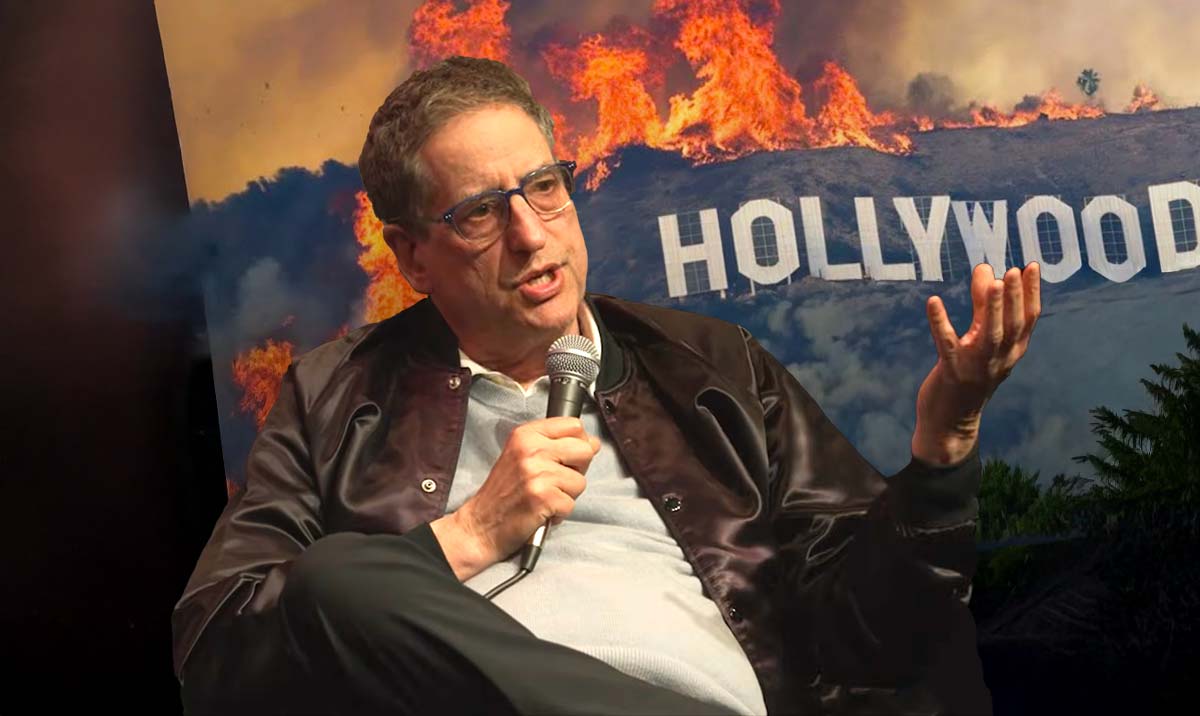
Hollywood’s always faced turmoil, but arguably nothing has damaged the film and TV industry as much as the long-lasting repercussions and consequences of COVID; from shattered theatrical routines and shortened windows that collapsed theatrical exclusivity, to streaming-era overcorrections that warped value and hollowed out the middle of the market, the business is still operating inside those aftershocks. That’s the backdrop that Sony CEO Tom Rothman brought to The Town podcast this week—not as a triumphalist recovery narrative, but as a clear-eyed warning that Hollywood needs to align and coalesce behind several key issues if it hopes to properly rebound and sustain the business.
READ MORE: The 150 Most Anticipated Films Of 2026
At the center of his argument is a simple point: the post-COVID era didn’t just scramble release patterns—it conditioned moviegoers to expect films at home sooner, undercutting theatrical urgency and making it harder for original movies to break through.
The Sony chief framed the current moment as one of the industry’s major historical disruptive inflection points and placed the windowing fight inside a larger power shift in Hollywood, arguing that the business is no longer competing on the same economic terms it once did.
To make that case, Rothman pointed to “the entry of truly hyperscale technology companies into our business at a level of capitalization beyond anything that could ever [have] been conceived,” then paired that shift with what he called “the crisis in Windows.” In his view, those pressures converge because, for trillion-dollar companies, “the issues of profitability in the movie business [are] secondary to them,” and “they don’t have to play by Hollywood’s rules… and they actually don’t have to make a profit. It’s such a small portion of what their balance sheets are.”
At a more basic level, the exec argued that the industry is still misreading a core part of its own business, with windows remaining poorly grasped even now. “Windows are a very ill-understood aspect of our business right now,” he said, before tracing that confusion to the pandemic shock. Movies “went through a near-death experience in [COVID],” he said, and studios and exhibitors emerged from that stretch with “incorrect assumptions… about what the larger ecosystem needed and what was best for the larger ecosystem.” He cast those assumptions as understandable under crisis pressure, but destructive over time because they changed audience behavior across the market—not just for one studio’s slate.
He did not frame downstream platforms as the enemy. Rothman said home entertainment has repeatedly been treated as a threat before becoming “a great boon to the movie business,” and he extended that logic to streaming now. “Streaming… is a great boon to us. Netflix is a fantastic partner for us. We make a great, great deal of money on our pay-one window,” he said. The line he kept returning to was theatrical exclusivity: “The key to all of this is to protect the exclusivity, protect an exclusivity period for movies in movie theaters.”
On the economics, Rothman argued the business has now learned the hard way that theatrical and streaming performance are not in conflict when the window is protected. He called it “a settled question—the statistics show that’ movies perform better on streaming after a real theatrical run. He also pointed to Sony’s own experiments during the disruption. “We actually did some movies in 17 days,” he said, then explained that the company initially looked at the wrong metric. The post-day-17 drop did not look dramatically worse than usual, suggesting the audience pools might be separate. Then, he said, they saw where the damage was happening: “You’re not losing them in that weekend—you’re losing them in the opening weekend.”
That habit shift sits at the center of his argument. Rothman said audiences do not need to track studio-by-studio policy to internalize a broader pattern. “We’ve made the audience think that they don’t have to go to the movie for a story-based reason,” he said. “We’ve made them think that they can see it at home. Maybe not today or tomorrow, but soon. They don’t know. They don’t distinguish between people putting it out in 17 days. But if enough movies come out in 17 days, they know. Maybe not today or tomorrow, but soon. And they’re not idiots.”
For Rothman, the business is a chain of successive windows, not a one-step transaction. When The Town’s host Matt Belloni asked what he would decree as “mayor of Hollywood,” Rothman answered with a clear benchmark: “45 days to transactional, 100 days to free.” He tied that to what he sees as the industry slowly relearning the economics after the pandemic shock, saying, “We went through a once-in-a-generation crisis with this COVID shit. And people are learning. We’re learning.”
To explain why this matters beyond pure box office math, he reduced moviegoing to two motives. “There are only two reasons people go to the movies,” Rothman said. One is experiential—the big screen, the night out, the social ritual. “The second reason is story-based. I want to see that story. I want to see that star. I want to experience that emotion.” Then he connected the point directly to windows: “If you take away the window, you take away the story-based reason to see it, leaving only the experiential reason.”
That logic runs straight into his originality argument. Rothman said the biggest issue is not output volume or the top of the market. “What’s the crisis in movies now? It’s not the [number] of movies. It’s not the big grossing movies. ‘Spider-Man’s gonna do great. It’s the middle ground. It’s originality. The crisis is originality,” he said. He extended that into a franchise question the business keeps circling: “The crisis is, where is the next franchise coming from? Because original movies don’t have a built-in fan base… you’ve got to have cultural urgency to get over the bar.”
He gave that point a practical frame, too. “The theatrical bar has gotten higher and higher and higher,” he said, but he rejected the idea that this is a complaint about audiences wanting recognizable titles. “Don’t be a snob. We’re in the audience business,” he said, while noting that many top-grossing films are “the best movies that are pre-branded for the audience.” He contrasted that with recent titles that had to build momentum without a built-in franchise identity, citing “Sinners” and “Anyone But You.”
Later in the conversation, he made clear that he does not force every success story into the same release model. Discussing Netflix and “K-Pop Demon Hunters,” he called theatrical “the parachute business—meaning you open or you die,” then argued that some titles benefit from a platform where word of mouth can build over time. He said “K-Pop Demon Hunters” found the right home because “the repeat viewing is free.”
He also warned against mistaking a good year for a repaired system. Rothman said 2026 is likely to “look rosy,” but he stayed on the same point: “This is going to be an incredibly great year… It’s going to look rosy. I will still stick with what I said. We don’t fix the windows. That’s going to be illusory. Fix the windows. Fix the windows.” He paired that with a warning about exhibition pricing, describing a “pricing spiral” in which lower admissions drive higher ticket prices, which then pushes admissions down again.
After all the economics, market structure, and distribution strategy talk, Rothman closed on the standard he kept returning to in different forms. Asked what a traditional studio can still do that hyperscaled companies can’t, he reached for a line he attributed to Beyoncé: “Make dope shit.”
That sounds like a lot, but it’s the tip of the iceberg. The two-part conversation is fascinating to watch in full, so check out the full Q&A below.

Rodrigo Perez is the founder and editor-in-chief of The Playlist, which he launched in 2008. He has worked in entertainment journalism since 2000, including at MTV, and has written for SPIN, IndieWire, Pitchfork, Complex, Magnet, and various music, film, and entertainment publications over the past two decades.

