


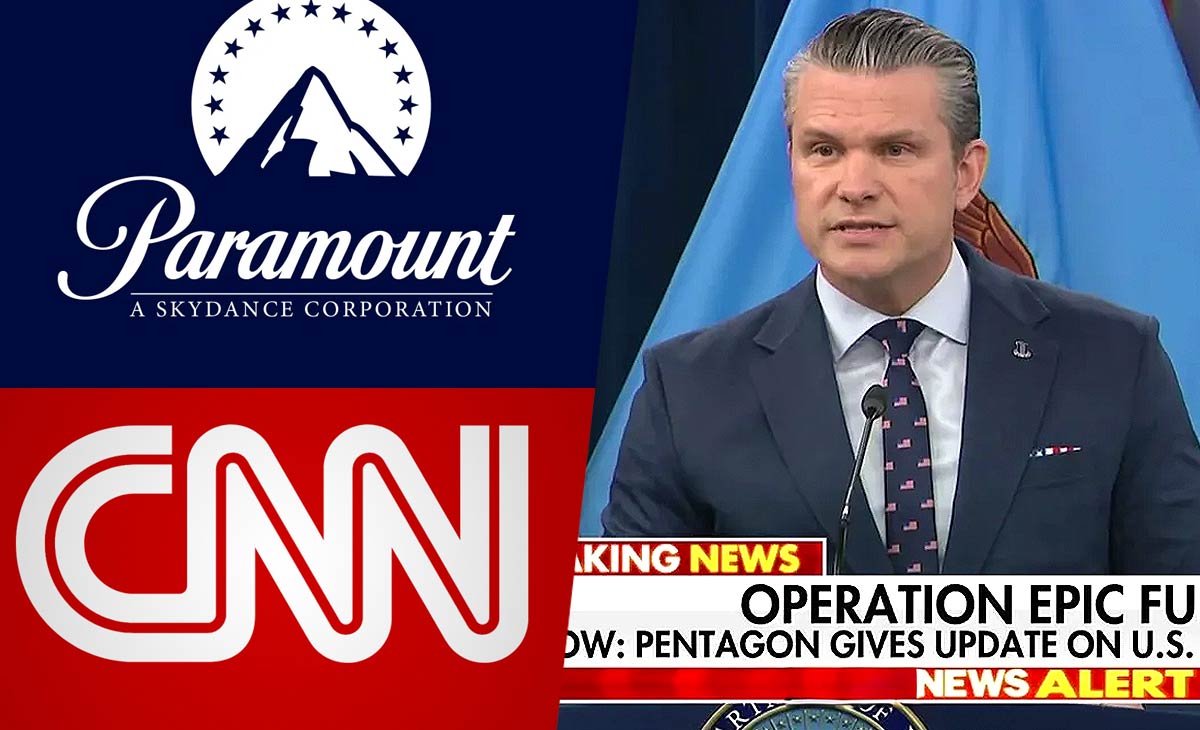
There are political slipups, and then there are those all-too-familiar Trump-era moments when the administration’s real desire lurches into public view through a fog of stupidity, incompetence, brazen arrogance—or some toxic mix of all three. During a Pentagon briefing on Friday, Pete Hegseth blasted CNN’s reporting on the Iran war and then blurted out the line that will now hang over this entire merger fight: “The sooner David Ellison takes over that network, the better,” he said. That is not a stray insult. That is a sitting defense secretary openly cheering for a politically connected buyer to take control of a news outlet that this White House has treated as an enemy.
The timing could hardly have been worse for Ellison. His Paramount Skydance is pursuing Warner Bros. Discovery in a deal Reuters reported at roughly $110 billion, one that would put CNN under his control if it closes and still requires federal approval. Days earlier, Bloomberg reported that Ellison had tried to calm fears by promising that CNN’s editorial independence would be maintained, saying it was upheld at CBS and would be upheld at CNN. Hegseth’s outburst cut straight across that pitch.
The political attraction around CNN was already sitting there in plain view before Hegseth said any of this. Axios reported that Ted Sarandos said Netflix’s White House outreach lost its appeal once it became clear the streamer was not “in the CNN business,” adding, “He didn’t care that much more about our deal.” That account does not prove the existence of a formal arrangement on paper, however, it does tell you what had value in the room. CNN was not incidental to the conversation. It was one of the reasons the conversation mattered.
That is what gives Hegseth’s comment its real stench. It takes a suspicion that had been circulating about the deal and strips away the last bit of plausible deniability. Trumpworld has spent years treating CNN as a political irritant, not merely as another media property. Put that next to a politically aligned bidder, a government approval process still hanging over the transaction, and a cabinet official publicly saying he cannot wait for the new owner to take over, and the picture is not especially difficult to read.
Anyone wondering what an Ellison-led newsroom makeover might look like already has a recent example. Reuters reported in October that Ellison installed Bari Weiss as editor-in-chief of CBS News after Paramount Skydance acquired The Free Press in a deal estimated at $150 million. Reuters also reported that Weiss came in without a traditional broadcast-news background and that Ellison framed the move around bringing a wider ideological mix to CBS. Critics did not need much imagination to see that as a signal.
Hegseth’s own record only makes the remark look less accidental, not more. Reuters reported that he has tightened Pentagon press access to the point that about 30 major news organizations have given up credentials under the new system. The fight with CNN did not emerge from nowhere. It came from an administration already treating the press as something to pressure, discipline, and route around when coverage becomes inconvenient.
While Ellison can keep insisting CNN will remain independent under his ownership, Hegseth just made clear why so many people will hear that promise and reach for the fine print. A White House that sees CNN as a political problem is plainly capable of seeing this merger as a political opportunity. Hegseth said that part out loud.
If there was any doubt about the kind of press environment this administration wants, Brendan Carr helped clarify it on Saturday. Reuters reported that the FCC chair warned broadcasters they had to “correct course before their license renewals come up” and said they could lose their licenses if they failed to operate “in the public interest,” remarks he made while amplifying Trump’s attacks on coverage of the Iran war. Put that beside Hegseth openly cheering for David Ellison to take over CNN, and the message comes through clearly enough: this White House is not merely raging at coverage it dislikes. It wants a press culture that falls in line with its politics, its priorities, and its methods.
Trump made the project even plainer over the weekend. After lashing out at what he called “terrible reporting” on the Iran war, he shared an infographic on Truth Social boasting that “PRESIDENT TRUMP IS RESHAPING THE MEDIA,” turning his campaign of pressure against the press into a kind of public victory lap. Next to Carr’s threat that broadcasters must “correct course” and Hegseth’s enthusiasm for friendlier ownership at CNN, it no longer looks like scattered grievance or improvisational bluster. It looks like a coordinated desire to bend the media into ideological alignment.
CNN answered with the response it had to give. “We stand by our journalism,” spokesman Mark Thompson said, adding that “no amount of political threats or insults is going to change that.” But this is bigger than one network trading statements with one administration official. When a president brags about “reshaping the media,” his FCC chair warns broadcasters about their licenses, and his defense secretary openly pines for friendlier ownership of a rival outlet, the warning is not subtle. This administration wants a press corps it can intimidate, discipline, and eventually bend to its will. Any newsroom that thinks the pressure stops with CNN is fooling itself.

