




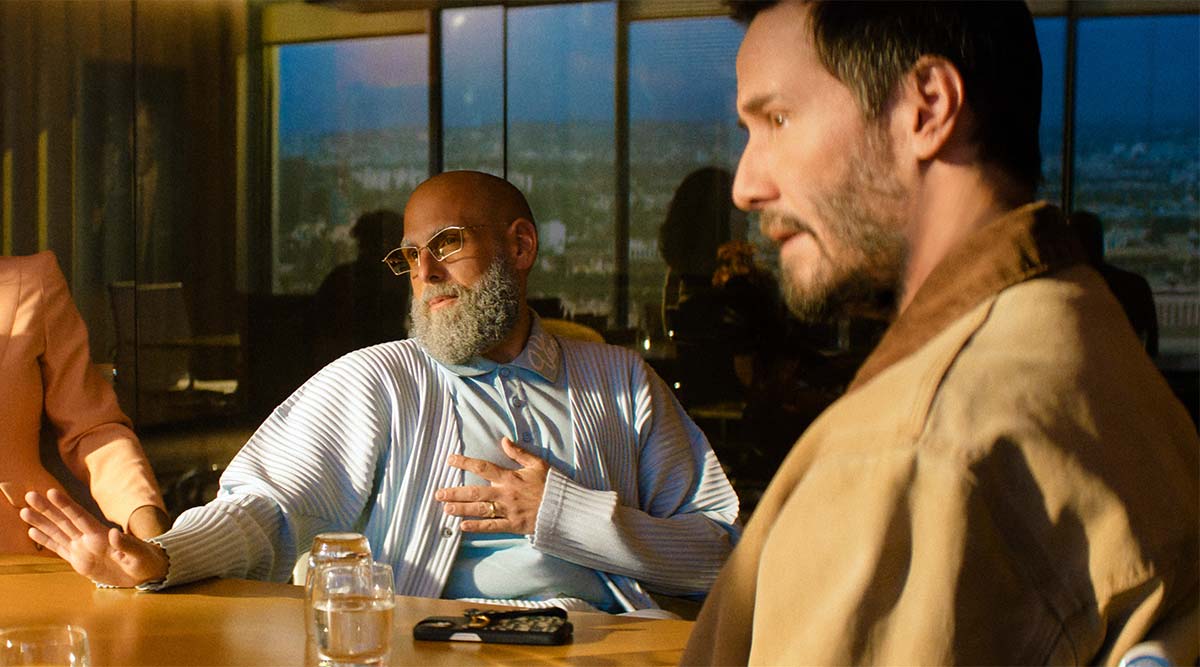
It is almost impossible to watch Jonah Hill’s new comedy “Outcome,” a shockingly insufferable train wreck, without reading it against his own public image—the carefully curated veneer of which has been punctured over the last few years. Unfair? Uncharitable, even? Absolutely. But the film practically demands this cross-examination. “Outcome” leans so hard on the tension between self-examination and self-exposure that it ends up revealing far more about itself, and its maker, than it seems to understand.
The setup, on paper, has bite. Keanu Reeves plays Reef Hawk, a beloved Hollywood star recovering from a five-year heroin addiction that never went public. Cleaned up and ready to resurface—getting prepped for the “Where have you been all this time?” interrogations sure to come—his triumphant return is threatened by blackmail and a mysterious video that could wreck his career. With help from his cartoonish crisis lawyer, Ira, played by Hill, and his lifelong friends—and hangers-on—Kyle and Xander, played by Cameron Diaz and Matt Bomer, Reef embarks on a soul-searching apology tour, retracing old grievances in hopes of figuring out who is blackmailing him while Ira tries to buy him time. Framed as the story of a famous man forced to confront his hidden demons while trying to salvage his future, it really plays like a thinly veiled portrait of Hill himself—his insecurity, his distorted relationship to celebrity, and the self-serving fantasy that he somehow heroically survived it all.
Martin Scorsese appears as a wizened old manager whom Reef discarded the moment he started to outgrow him; Laverne Cox, Kaia Gerber, Roy Wood Jr., and Susan Lucci drift through the margins as part of Reef’s orbit and crisis machine, but none of them can rescue this disastrously clueless movie.
For one, yes, it’s trying to subvert his charisma, but Reeves is terribly miscast as the narcissistic celebrity who is secretly a terrible person—he cannot even convincingly fake being that shitty. But that is almost the least of the movie’s problems, because the real subject here is Hill’s id, ego, and self.

It is not hard to trace the roller coaster of Hill’s last decade and see how it applies. Two Oscar nominations reportedly swelled his ego and alienated people in his circle. Then he retreated from acting and public life and pivoted toward filmmaking, suggesting someone in transition or recalibration. “Mid90s” was a modest but promising coming-of-age drama. “Stutz” pushed even further inward, framing itself around mental health, vulnerability, and the language of self-improvement. Then came public allegations from an ex-girlfriend about manipulative gaslighting and the weaponization of therapy-speak, which recast “Stutz,” and whatever Hill seemed to think he had learned from it, in a much darker light.
“Outcome” arrives carrying all of that baggage, whether Hill wants it to or not, and the movie plays like a queasy melange of those impulses—a celebrity satire, a therapy-speak character study, a blackmail farce, and a self-lacerating confession that never cuts deep enough to draw blood.
And what makes the film so uncomfortable is that it does not merely gesture toward narcissism, public shame, and strategic contrition as cultural phenomena; it feels deeply entangled in them. The panic over public perception, the retreat from an audience that has turned, the desperate need to control the story, the craving for grace after a fall—all of it suggests a movie still trapped inside the very anxieties it wants to diagnose. Not a literal autobiography, but an emotional one.
That premise should have been fertile ground for a ruthless Hollywood comedy about apology culture, image resets, selective accountability, and the privileged bubble where nobody tells the famous person the truth. “Outcome” clearly wants to tap into that cultural decay, exploring a public life where people demand grace and empathy for themselves while extending none to anyone else. It wants to skewer the absurd machinery of the apology tour, the soft-launched comeback, and the manicured insincerity of strategic atonement. It wants to expose how every fall from grace can be repackaged as a branding opportunity, while still asking us to remember that, even these vain, self-involved celebrities, are human underneath it all.
But that is exactly where the film gives itself away. Rather than feeling incisive, it feels self-serving—a reputation-laundering movie about reputation-laundering, more interested in pleading for sympathy than delivering real critique.
And then there is the writing. So much of the dialogue is blatant exposition in the clumsiest possible form—spoon-fed, glaringly obvious, and delivered with such cloying emphasis that scene after scene feels like a bad note session performed out loud. Characters explain wounds and plot mechanics, with no trust in the audience and no ear for rhythm.
Apart from a few admittedly hilarious one-liners, “Outcome” is brutally unfunny—painfully so at times. Hill plays Ira so broadly and so relentlessly pushed that the turn starts to resemble a minstrelled Jim Carrey filtered through pure anxiety and mugging self-delusion. It borders on grotesque caricature. He is clearly having a wonderful time, while the movie itself is dying. It’s comedy masked as self-deception.
That desperate, sweaty need for approval becomes the film’s dominant note. There is a fragile ego trembling beneath nearly every joke, tantrum, apology, and self-protective gesture. The whole thing plays like 90 minutes of laughter from a filmmaker who cannot stop smiling ear-to-ear, asking, “Yo, am I the asshole here?” without ever really being prepared for the answer.
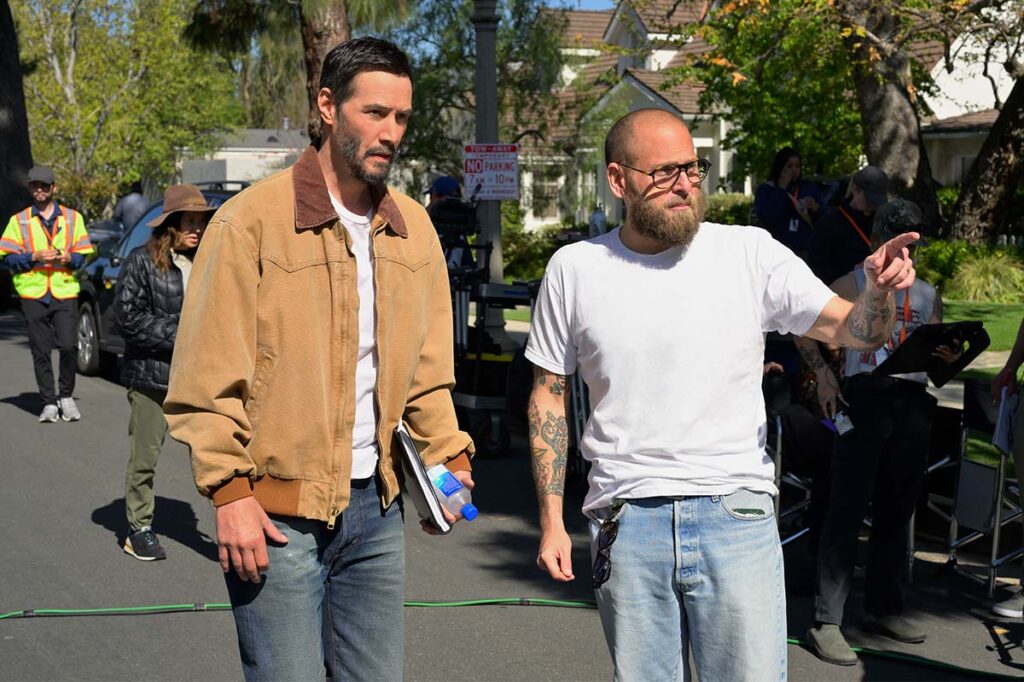
That same hippy-dippy spirituality Hill has been projecting in recent years hangs over “Outcome,” too, especially in the back half, where the film starts reaching for redemption, healing, and hard-won emotional honesty. But it all rings phony—a posture of sincerity. And that gets at the movie’s real subject: a fraud terrified of being exposed as a fraud, making the meta-nescience of it all more glaring.
That is the movie’s grand irony. “Outcome” wants to skewer narcissism, performative apology, and a lack of self-awareness, yet it is crippled by a brutal self-awareness deficit of its own. Reeves never lands remotely near the corrosive monster the movie needs at its center, which leaves Hill’s sensibility as the real force shaping the film—and that is where it curdles into something smaller and uglier: not a merciless dissection of celebrity ego, but a self-pitying work that treats public disgrace as misunderstood suffering.
So yes, “Outcome”—and it’s bad scenes shot behind obvious blue screen and fake, manufactured sunsets—is terrible. But what makes it memorable is the queasy way the movie keeps collapsing into the very pathology it thinks it is exposing. It wants to mock the famous for living inside a bubble of privilege, paranoia, and vanity, yet it ends up sounding like it was made from inside that bubble.
Nobody in “Outcome” seems willing to tell the movie star the truth about himself. The bitter joke is that nobody seems to have told this movie, either. [D-]