


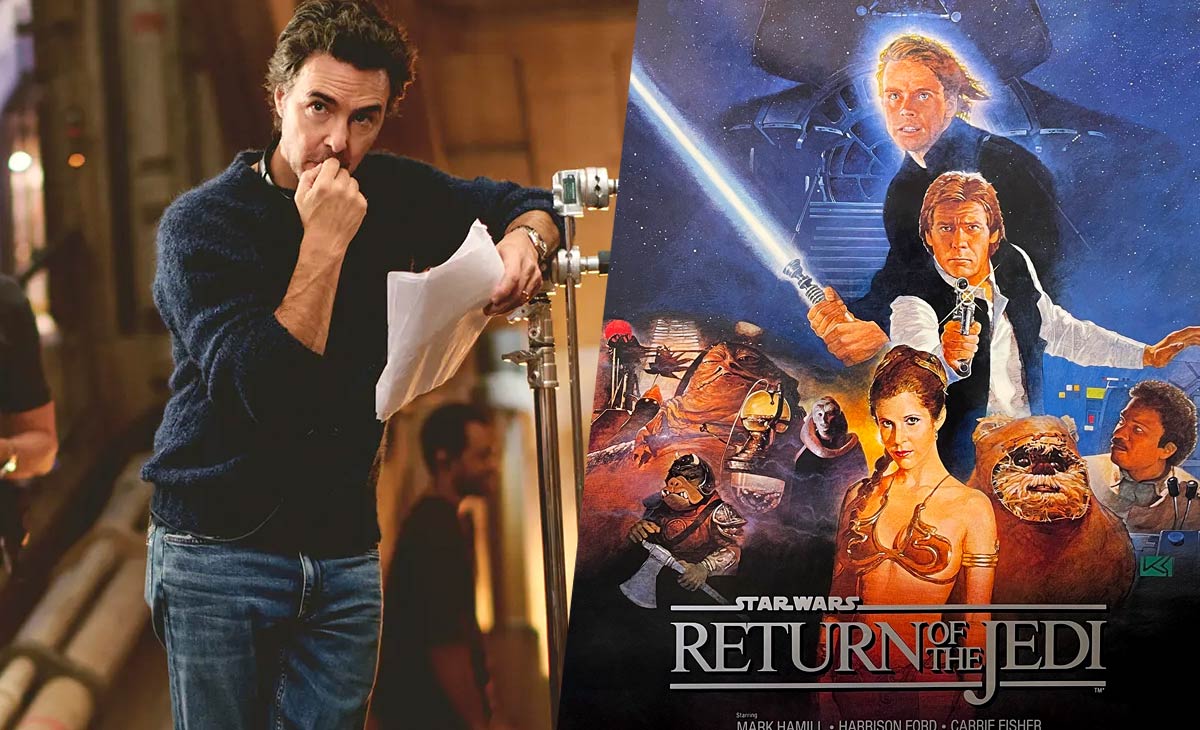
For most filmmakers handed a new “Star Wars” movie, the altar of “The Empire Strikes Back” is the obvious place to kneel; for decades, it’s been the canonical “director’s film” of the original trilogy. But populist filmmaker Shawn Levy, known for warm-hearted popcorn rides like “Free Guy,” “The Adam Project,” and the “Night at the Museum” movies, is framing his upcoming “Star Wars: Starfighter” differently. For his own trip to the galaxy far, far away, the movie that really wired his brain — and the tonal compass he’s chasing — is the trilogy’s most unabashedly lighthearted entry, “Return of the Jedi.”
Speaking on the On Film With Kevin McCarthy podcast, Levy says he knows exactly which titles fans expect him to drop, but he’s honest that the movie actually rattling around inside “Starfighter” is the third film. As he puts it, “If I’m being honest, I know the cool answer would be ‘Empire,’ and sort of the inarguable answer would be ‘A New Hope,’ but it’s kinda ‘Jedi.’ It’s ‘Jedi’ because of the combination of theme, levity, adventure, heart, and spectacle. Somehow that movie just got it right for me.”
He ties that directly to his own experience as a kid, going back to the same movie until it became part of his DNA, and says that feeling is still there while he’s shooting. Levy recalls that he “saw that movie so many times in a theater, more times in a theater than ‘New Hope’ and ‘Empire,’ and it stuck with me,” and adds that “There are moments where I’m on set, and I feel like that kid is with me in the director’s chair. I’m there making his dream come true. It’s absolutely incredible.”
At the same time, he’s clear that the job isn’t just wish-fulfillment. Levy talks about the pressure of working in a space where audiences already have years of emotional investment and expectations. Looking back at his own history with franchises and the way sequels get made, he doesn’t pretend it’s easy. “Having seen how the sausage of sequels is made, I find the whole subject a little stressful because you want to get it right for the audience,” he says.
That anxiety is heightened by the fact that “Starfighter” really isn’t bolted to any familiar corner of the mythology. Levy makes a point of explaining that this is not a continuation of someone else’s story or a prequel filling in a blank. He says the film is set “five years after… after Nine, after ‘Rise of Skywalker,’” and spells out what that actually means: “Especially with ‘Starfighter,’ it’s not a sequel. It’s not a prequel. It is not legacy characters, and it’s not in a period of time in the galaxy that’s ever been explored.”
Because of that, almost every frame has to be invented from scratch while still feeling like “Star Wars.” Levy describes the day-to-day process as a barrage of extremely specific decisions about the movie’s look and feel. He talks about the “desire to make design choices, character choices, planet choices, costume choices, droid choices, alien choices,” and says “all of it needs to feel ‘Star Wars’-y,” even though they’re not simply copying designs from the original trilogy.
If there’s a single note he says he’s heard consistently from the top, it’s about pushing into new territory rather than just coloring inside the lines. Levy explains that “the mandate I’ve gotten from Disney and from Kathleen Kennedy and Lucasfilm to forge new ground,” and adds that “it’s been the one constant ever since I gave them an outline of this movie.”
Levy also lays out how he actually ended up with a “Star Wars” film at all, and it didn’t start with a spaceship; it started in an editing room. He remembers being deep in another project when his phone rang. “I was editing ‘All the Light We Cannot See,’” he says. “We were still trying to craft a story on ‘Deadpool/Wolverine,’ and it was like October or something. And my phone rang, and it was Kathy.”
He says he already knew Kathleen Kennedy somewhat from earlier in his career and didn’t expect what came next. “I’m like, ‘Hi, Kathleen Kennedy,’” he recalls, before explaining that he’d been “one of the 40 directors who raised their hand with interest nine, 10 years ago when Disney first acquired Lucasfilm.” This time, though, she was calling with something concrete. “She called, and she said, ‘I want you to do Star Wars,’” he says. “And I said, ‘Which one?’”
What threw him was how open the offer actually was. Levy says Kennedy didn’t respond with a specific character or title, but with a blank canvas. “She said, ‘Anyone you want,’” he remembers. “And I said, ‘Right, but like, which character, what movie is it?’ And she said, ‘You pick the writer. You pick the story. Just make it feel like a Shawn Levy movie. Make it warm-hearted, fun, and built for audience delight. That was the only mandate.’”
Once he had that directive, Levy knew exactly who to call. He says, “And so I picked Jonathan Tropper. We came up with a new story from scratch,” leaning on a writer he’s worked with before and who already understands his sensibility. From that point on, he says, that same combination of originality and warmth has been the north star: a new patch of “Star Wars” that still feels like one of his movies.
If he needed proof that the idea was landing, he says he found it when he took the project to fans in person. Levy describes bringing “Starfighter” to “Star Wars Celebration” in Tokyo earlier this year and feeling a very specific kind of response. “We went to ‘Star Wars Celebration’ in Tokyo,” he says. “Maybe it was April, and the excitement I felt in that place, not only around Ryan Gosling and the movie, but what I also felt in that room, is this thirst among the fans for something different, something new. So that’s my everyday North Star that I’m chasing.”
Taken together, Levy isn’t chasing the chilly myth-making of “The Empire Strikes Back” or the grim war-story mode of recent entries. He keeps pointing to “Return of the Jedi” as his tonal north star and to a studio that, this time, has told him to build something new, warm, and unapologetically crowd-pleasing — the kind of “Star Wars” movie he remembers going back to see over and over as a kid.

Rodrigo Perez is the founder and editor-in-chief of The Playlist, which he launched in 2007. He has worked in entertainment journalism since 2000, including at MTV, and has written for SPIN, IndieWire, Pitchfork, Complex, Magnet, and various music, film, and entertainment publications over the past two decades.

