


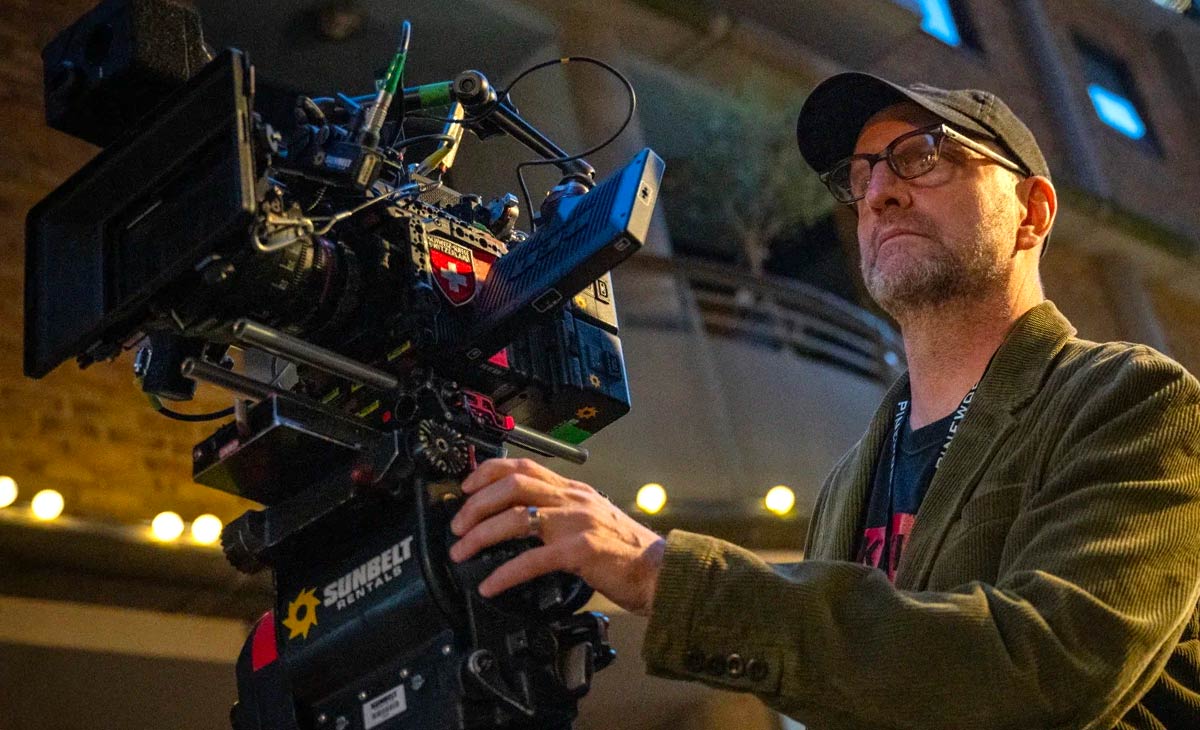
For all of Steven Soderbergh’s restlessness as a filmmaker, what comes through most clearly is rigor. Forget nostalgia or self-mythologizing; the Academy Award-winning filmmaker is far more interested in continuing to stress-test his own work against a moving standard—what lands, what doesn’t, what taught him something anyway, and what still feels worth chasing. That forward-thinking propulsion was the theme of our recent conversation about “The Christophers,” Soderbergh’s new Ed Solomon-written chamber dramedy, which starts with the bones of an art-heist movie and then turns inward, becoming something knottier, sadder, and much more human (read our review).
In the film, a once-famous London painter named Julian Sklar, played by Ian McKellen, has retreated into bitterness and self-imposed seclusion while his estranged children, played by James Corden and Jessica Gunning, recruit a young painter and sometime forger, played by Michaela Coel, to gain access to his unfinished canvases and help secure the inheritance they fear will never come. But “The Christophers” does not stay a caper for very long. Almost immediately, it slips sideways into a sharper, more intimate two-hander about grievance, artistic decline, legacy, and the lies people tell themselves when they stop evolving.
In our conversation, Soderbergh discussed the abandoned Adam Driver-led “Star Wars: Ben Solo” movie he no longer has any interest in reviving, the two different James Bond ideas he once pitched to Barbara Broccoli, and why “Contagion 2” probably is not happening. But the career-spanning discussion ran deeper than franchise near-misses and stalled what-ifs.
The filmmaker also discussed returning to writing as a practical act of self-determination, his ever-expanding “Jaws” project that has now mutated from book into app, and the long-promised limited-edition seven-film box set of his early independent work, which includes “Mr. Kneff,” his radically recut version of “Kafka”—essentially reimagined as an experimental near-silent film with new music. Even when he talks about older work, Soderbergh does not sound trapped in nostalgia; he sounds like an artist still revising, recalibrating, and figuring out what each misstep might still yield. Here’s the rest of our conversation.
How do you assess whether something worked or did not work?
On the one hand, you can’t really trust any artist talking about their own work. On the other hand, you’ve got to have some mechanism for assessing whether you succeeded with a particular project, and that isn’t strictly commercial or strictly critical — it’s a combination of things.
The other complicating factor is what I was saying before: often, you can’t just — I mean, some people can, I can’t — leap from mountaintop to mountaintop. There have to be valleys in between, where you pick up the knowledge and skills that help you get to another mountaintop. And I accept that.
Looking back at your work, are there films you know didn’t quite come off—and what do you see in “Kafka” now, especially given the “Mr. Kneff” reworking?
There are things I’ve made that people don’t like, and they’re right. I know why they don’t like them, and I go, yeah, that doesn’t really come off. And then there are things that people don’t like, and I feel, well, I wouldn’t change it, so I guess the expectation somebody had just wasn’t met at any level. Not a lot I can do about that.
“Kafka,” I made some of the classic sophomore mistakes — an inconsistent tone. It’s a classic young filmmaker mistake. I knew that at the time, because I had to do a serious amount of work just to get that movie into the shape you saw. Massive reshoots. Looking back on it, yeah, it didn’t really come off. There are things in it that are interesting, but its role in my career was important in the sense that it was a large-scale production that I managed to keep under control, and when it needed to be radically rethought and recalibrated, I didn’t panic. I just did the work and got it in as best shape as I possibly could. So it was instructive in a way that sometimes a success isn’t.
You and David Fincher have long made that “movie” versus “film” distinction. Has your relationship to that changed? Also, “The Christophers” arguably straddles both.
Yeah, that’s probably true. The sort of brute-force breakdown among people I know is that a movie’s for the audience and a film is for yourself. That’s a rough-justice description, but I’ve tried to be, in my dotage, much more conscious of the audience than I was earlier in my career. I’ve always thought about the audience, and I’ve always tried to play fair with the audience while respecting them and challenging them to pay attention.
But I think even more so in the last decade, I’m really going through it bit by bit and assessing whether it’s doing for the audience what it is intended to do.
You mentioned once writing a second “Sex, Lies, and Videotape.” What happened with that?
I’m gonna turn it into a novel, I think. It was the kind of thing that had to happen right then, or it felt like the window had closed. Through circumstances, it just didn’t happen immediately—it almost did. And then going back and thinking about it, the ideas in it that I’m really interested in, that I think expand the philosophical footprint of the first film, would actually be better served in prose.
For years, you kind of proclaimed you weren’t a real writer and only did it as an entryway into the business. But that changed during COVID when you wrote three scripts, and you continue to do that now. What changed?
The alternative was to start reading a lot of scripts and soliciting offers, and looking for open assignments, which I did. But I felt like that’s not enough. You can’t just sit here and wait for something to come over the transom.
So I got in the Wayback Machine and started doing what I did back then, which was to write one thing, and when that was done, start another thing. The good news is that I can take advantage of all the hours I’ve spent in rooms with great writers. That’s the difference between me writing now and writing 25 years ago. I’ve learned a lot from people who do this for a living.
Presumably, you’re trying to make one of the three scripts you mentioned in your 2026 Seen/Read list?
Trying. There’s one I picked that I felt had the best shot, and I’m trying to put that together.
“The Sot-Weed Factor” is one of those you tried to make ages ago. Is that still something you want to do?
Well, I have a script now that I think works, but I decided to pick one of the other ones.
You’ve been talking for years about the “Jaws” project, which started as a book and is now an app. When are we going to see it?
Really soon. I’ve got the beta of it on my iPad right now. We’re really close. Apart from the little technical tweaks we keep doing, the vetting process to get into the iOS App Store is intense. So we’re really, really close. I’m really happy with it.
How did that evolve from a book into something much bigger?
It started with a few lectures I gave, and I thought I should memorialize them somehow, because it was about trying to download everything I’ve learned. But that didn’t seem like enough. So then I thought, okay, I’ll pick the movie that activated me and use that as the spine to talk about directing in general.
That was better. But then I thought, what if I tried to recreate every day of shooting on that? You would need to see the images, and that’s when it shifted from a book to an app where you could scroll through everything shot every day. It’s an experience.
Has Spielberg seen any of it, or talked to you about it?
He’s aware this is happening because I talk about it so much, and he’s been very generous in answering some questions that only he knows the answer to. He’s supportive of the idea, but he hasn’t seen it yet. I want to send him the beta. I don’t want to just ambush him with this thing.
And lastly, the box set—still this summer, with seven films, I believe?
Seven and a half, yeah, because it has the redux of “Kafka” {ed. note: “Mr. Kneff”}. That’s why this all happened. The various rights deals lapsed, and the rights holder, Pathé, had been kind of sitting on it, knowing that I was working on this recut. They’ve allowed me the physical media rights only for this boxed set, but I think the plan is that once this thing is out in the world, they’ll try to start relicensing them so people can stream them and all that.
The other films in the set, once their rights lapsed and reverted back to me, had also been unavailable. So I’m hoping I’ve stoked enough interest to sell it. It’s a limited run—each one is serial-numbered. This is for hardcore fanatics.
Will any of that stuff, including “Mr. Kneff,” play theatrically again?
It would take somebody saying, “Can I get a DCP of that title?” Sure. We’ve been working on that for too long. We’ve got to get it out there.
“The Christophers” is in theaters now in limited New York/Los Angeles release and begins expanding next week.

Born in Chile, raised in Canada, now living in Brooklyn, NY, Rodrigo Perez is the founder and editor-in-chief of The Playlist, which he launched in 2007. He has worked in entertainment journalism since 2000, including at MTV, and has written for SPIN, IndieWire, Pitchfork, Complex, Magnet, MuchMusic, and various music, film, and entertainment publications over the past two decades.

