


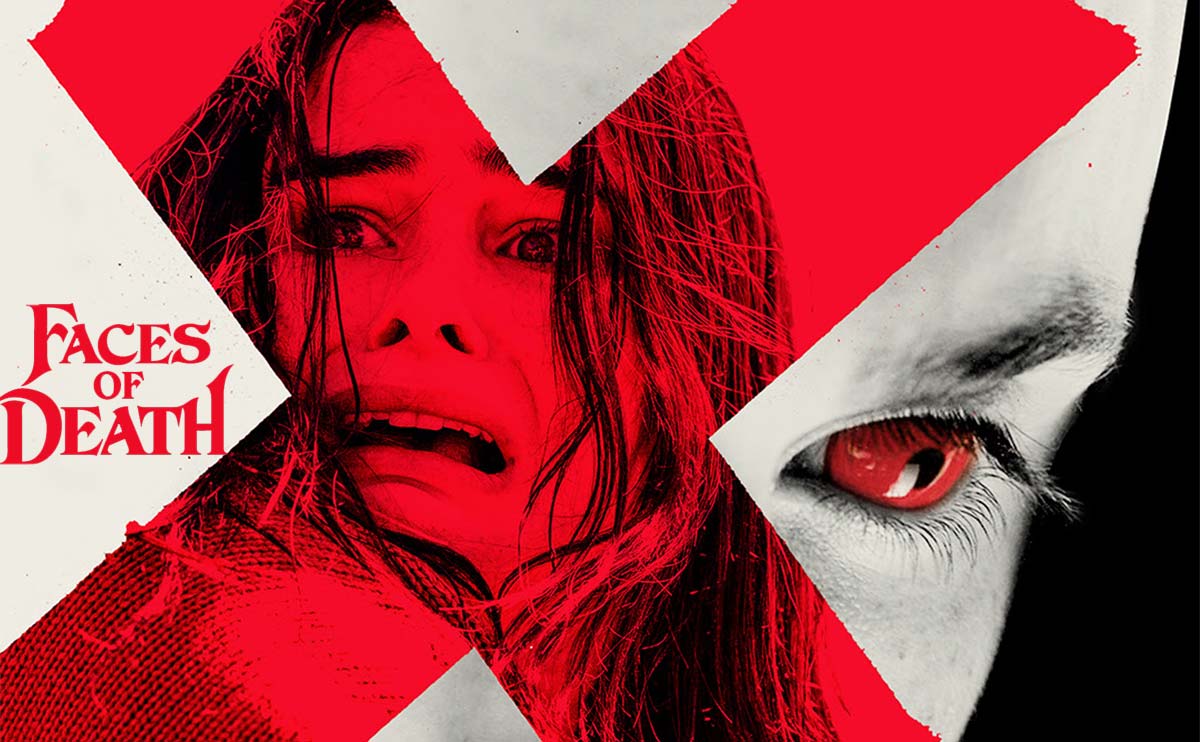
“Content is king,” “give the people what they want,” “abide by the algorithm”—those dead-eyed mantras of online culture are the broadside target of Daniel Goldhaber’s “Faces Of Death,” a painfully misguided remake that borrows the grubby notoriety of the original mondo exploitation film to mount a sneering lecture about our increasingly corrosive digital world. Filled with flattened ideas about the attention economy, the ill-conceived horror aims at all the usual suspects of modern life: doomscroll-numbed TikTok fixation, digital narcissism, and a bottomless appetite for the trivial over anything with actual human value.
The film follows Barbie Ferreira’s Margot Romero, a content moderator with a hidden past, inured to the daily grind of filtering online depravity until a run of videos surfaces that appears to reenact murders from the original “Faces Of Death” cult film from 1978. As the line between hoax, performance, and real violence begins to collapse, Margot is pushed into a paranoid spiral involving her apathetic coworker Gabby (Charli XCX), her incurious, click-motivated boss Josh (Jermaine Fowler), her roommate Ryan (Aaron Holliday), shallow content creator Samantha Gravinsky (Josie Totah), and the deeply unsettling Arthur Spevak (Dacre Montgomery).
Cheap, glib, and meta in the same self-satisfied way the recent “Scream” films have been, “Faces Of Death” keeps mistaking scorn for complexity. Goldhaber, who co-wrote the screenplay with Isa Mazzei, plainly despises the online world he is depicting—the clout parasites, the attention junkies, the casual moral vacancy of people who turn every waking thought into content—but contempt alone is not insight. The target is easy, the satire blunt, and the movie rarely gets past its most obvious diagnosis.
“Faces Of Death” sat on the shelf for quite a while, always a bad sign, and the reason becomes obvious almost immediately. This thing is half-baked, clumsy, gross, and repellent on nearly every level—spiritually vacant, emotionally inert, and ugly in ways that go well beyond the gore.
The original “Faces Of Death” hangs over the film less as text than a fetish object, spoken of by the killer in reverent terms as though it were some primal viral artifact before virality, meme culture, and online brain-rot infected everything. But Goldhaber never finds much depth in that fixation beyond boilerplate psycho obsession: because the original was exposed as largely fake, the killer wants to “right” that perceived wrong with copycat murders that are brutally real.
From there, the movie broadens into yet another attack on phone addiction, validation hunger, and the cheap dopamine reward of likes and engagement. By that point, the film’s disdain is less pointed than exhausting, less critique than purge. Yes, influencer culture is shallow, vain, and spiritually deadening. That is not exactly a revelation. So when the movie responds by locking these people up and torturing them, it stops being commentary and turns into a nasty little revenge fantasy that wants credit for social critique while indulging the same diseased appetites it pretends to condemn.
It is as twisted as the characters it scolds—and not in any illuminating or productively transgressive sense. Goldhaber leans on cheap laughs, cheap shocks, crude performances, tin-eared dialogue, and a strain of self-protective reflexivity that keeps trying to excuse itself in real time. The performances do not help. Montgomery is especially bad, a try-hard menace that curdles into camp. Charli XCX is reduced to a flat note of indifferent snobbery, and Ferreira is left trying to carry material that gives her almost nothing to work with. Hanging over the whole cast is the depressing sense that they know they are trapped in something that is not working, but cannot do anything to rescue it.
It looks rough, too—flat digital imagery, poorly modulated lighting, and footage so visually vacant the whole thing feels bargain-bin from the jump. Worse, the movie seems to preempt criticism by folding it into the text: when someone calls out how lousy the killer’s footage looks, that failure is defended as an aesthetic choice, then weaponized against the person who said it aloud. That is the level of smug, defensive self-awareness Goldhaber is working with here.
For all its high-minded pretensions about serving as a metaphor for our immoral, apathetic, shallow culture, the only thing Goldhaber finally produces is a rote lo-fi slasher with the dimensions of a shabby think piece and the aura of something made on the thinnest budget imaginable. The whole thing is blunt, crass, and stupid—never clever, never especially incisive, forever straining to pass off disgust as depth.
After showing real promise with “Cam” and the engrossing “How To Blow Up A Pipeline,” Goldhaber loses the plot badly here. Call it third-film jitters: an ill-advised, thoroughly unpleasant misfire that sends the filmmaker stumbling backward instead of forward. In trying to use the genuinely wicked original “Faces Of Death” as a springboard for a critique of our depraved digital age, Goldhaber only exposes how flimsy the concept really is—hollow, nasty, and finally just depressing. For all its rage about moral decline and the psychic poison of content culture, “Faces Of Death” never rises above the same cheap sensationalism it pretends to condemn. Instead of confronting the sickness, it feeds on it and spits out something just as rancid as the faux snuff films it claims to abhor. [D-]

Born in Chile, raised in Canada, now living in Brooklyn, NY, Rodrigo Perez is the founder and editor-in-chief of The Playlist, which he launched in 2007. He has worked in entertainment journalism since 2000, including at MTV, and has written for SPIN, IndieWire, Pitchfork, Complex, Magnet, MuchMusic, and various music, film, and entertainment publications over the past two decades.
- Rodrigo Perez
- Rodrigo Perez
- Rodrigo Perez
- Rodrigo Perez
- Rodrigo Perez
- Rodrigo Perez
- Rodrigo Perez
- Rodrigo Perez
- Rodrigo Perez
- Rodrigo Perez
- Rodrigo Perez

