



In the sunbleached corridors of Athens, two ghosts wander without purpose. They peer at the living, haunted less by death than by the residue of life left unfinished. “How to Shoot a Ghost,” the new short from Charlie Kaufman and poet-filmmaker Eva H.D., drifts through that liminal space between memory and disappearance. After premiering at Venice and screening this week at AFI Fest, it marks their second collaboration following the tone-poem short “Jackals and Fireflies.”
READ MORE: ‘How To Shoot A Ghost’ Trailer: Charlie Kaufman Teams With Jessie Buckley For New Short
“When Eva asked if I wanted to make something there, I said yes,” Kaufman said. “I didn’t know Athens before. I wanted to do something that was accurate and felt like the city, and I was hoping that I could bring that.”
“We met each other at another arts residency, McDowell in New Hampshire, and became friends,” Kaufman recalled. “I actually included a poem of Eva’s in my movie ‘I’m Thinking of Ending Things.’ It’s recited by Jesse Buckley.” That trust lingered. “I think I like working with her,” he said simply.
Eva developed the new project while on residency in Greece and wrote it specifically for Kaufman after asking if he wanted to make a short set in Athens. Their partnership flowed naturally from “Jackals and Fireflies,” which began as one of her poems and later became a film.
“I love her poetry, and I find it’s moving to me, and it opens me up in a way to the world in which I’m living,” Kaufman said. “I can have a tendency to be very sort of closed and worried… and poetry has been sort of a— it frees me from that.”
“We probably wouldn’t be friends unless we shared some kind of aesthetic experience [and] concerns, I guess,” Eva said.
The film reunites Kaufman with Jessie Buckley, who starred in his aforementioned melancholy and existential dreamscape film, “I’m Thinking of Ending Things.” “I love Jesse and I love working with her,” he said. “I think she’s an extraordinary presence on screen. It’s kind of, you know, letting her do her thing.” Casting her on the previous feature hinged on Eva’s writing. “When I hired her for ‘I’m Thinking of Ending Things,’ it was based—the audition was the poem that Eva wrote because I knew that I was putting a whole poem in the thing… and Jesse was so very good at it.”
“She’s wild and extraordinary, just generally,” Eva added. “Her father’s a poet, her mother’s a harpist. She comes from an area of Ireland that’s all cliffs and wild winds blowing in the ocean. And that’s what she’s like.”
“I wouldn’t say it’s easier,” Kaufman said of the difficulties of making shorts instead of feature-length movies. “I think it was, you know, like making any movie, it’s always a challenge. However, it does allow us to experiment with things outside of the conventional narrative structure… because people want a return on their investment, and no one’s really expecting a return on their investment here. It’s obviously much less money, so yeah, and it’s shorter, and it allows you some freedom to play in that regard.”
Eva found Josef Akiki through a Lebanese filmmaker friend. “I love him,” she said. “He’s so lovable. And we found him because a friend that I had met in Greece… a Lebanese filmmaker named Ahmad Ghossein… suggested, I think, three actors and Josef was our favorite by a long shot. He’s a beautiful creature.”
The film’s texture is courtesy of Polish DP Michal Dymek. “He’s young,” Kaufman said. “He did the movie ‘EO.’ He’s very versatile, very talented, and he’s got a very open spirit.” A Greek collaborator, Yorgos Koutsoularis, provided lived-in city fragments. “We had [Yorgos] go out and try to capture… we’re very interested in street photography. We wanted to include that sort of as an element… of this movie and of the last movie.”
“Old men arguing and pigeons and people doing quirky things… and there were things that we got from him. We got the yellow speedo guy,” Kaufman laughed. “He’s so great and he’s so random, and that’s the kind of joyous thing that you can’t script but you see in a city.”
“Charlie was open to trying foods he hadn’t tried before or listening to people or like learning new words—just things that not all Americans are actually willing to do,” Eva said. “I mean, you’ve got to have humility when you go to someone else’s house.”
![‘How To Shoot A Ghost’: Director Charlie Kaufman & Writer Eva H.D. on Athens, Poetry & Jessie Buckley In Their New Short Film [Interview]](https://cdn.theplaylist.net/wp-content/uploads/2025/09/11120429/%E2%80%98How-To-Shoot-A-Ghost-Director-Charlie-Kaufman-Writer-Eva-H.D.-on-Athens-Poetry-Jessie-Buckley-In-Their-New-Short-Film-Interview-1024x673.jpg)
Asked about the look, Kaufman said, “It’s digital.” Eva added, “But Michal is so wonderful. They planned it so it would give you that feeling, right? Like the nostalgic feeling that film gives you.”
“It was moving around Athens on foot, basically, because you can’t really drive around there,” Kaufman said. “It was a very hectic shoot, but it was over in six days.”
The credits land on Lou Reed’s “Perfect Day,” newly recorded by Rufus Wainwright and Martha Wainwright. “It was, yeah, Rufus and Martha were the ones that did it,” Kaufman said. “We were trying to figure out what the end-credit song should be… and Eva suggested the duet between Rufus and Martha for this song. I approached his manager… and he said Rufus was really excited about the idea and Martha brings such a—yeah, and it’s very different.”
“It was nice that we didn’t know about it… Martha’s voice, because she was the first one I thought of… we were thinking of women with ethereal, otherworldly voices,” Eva said. “And then it was such a lovely idea to have the two. There are two ghosts.”
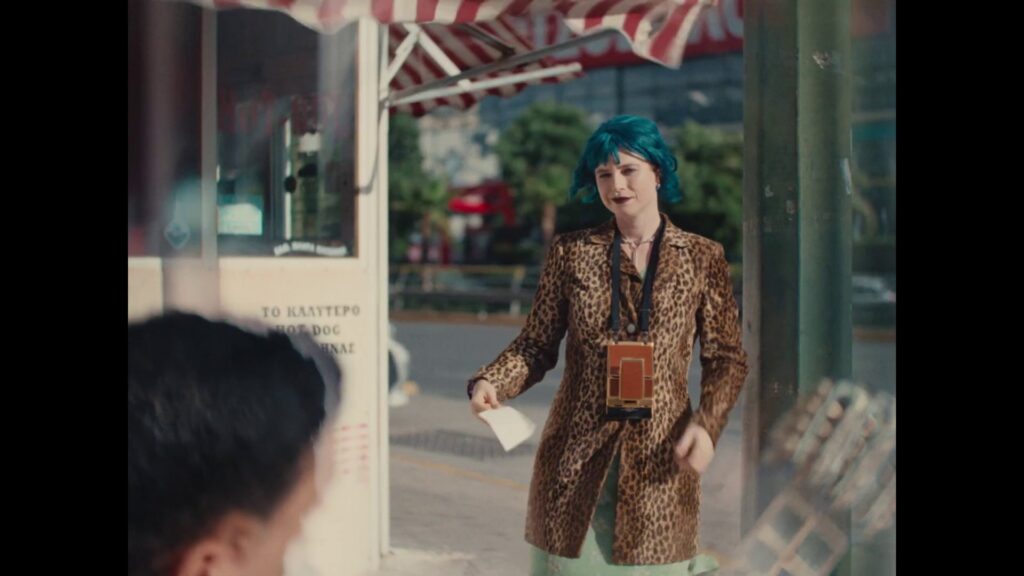
“Athens is a city that feels like it’s full of unfinished business, the remnants of the past that have not been addressed,” Eva said. “There is a way that we might move through our lives like ghosts in our own existence. I think most of us have probably felt that at some time or another… that you can see others perhaps, and they can’t see you, or that you are no longer capable of affecting your existence in an active way, which is true of our ghosts. They’re done.”
“We can all empathize with the ghosts because we’ve all felt this way,” Eva explained. “And we’re all heading that way. We will never tie off all the loose ends. That is simply not the way it works. We’re not going to leave a clean campsite behind us, however much we might wish to.”
Rumors about Spike Jonze were addressed head-on. “That’s completely not true,” Kaufman said. “It’s not what I said in Brazil. I was asked, Am I ever going to work with Spike again? And I said, I would like to. And I’ve talked to Spike about it. And we have no plans currently. That’s what I said. And then somehow it got turned into this.”
On future work: “We’re trying to get financing for ‘Later the War,’ and that’s ongoing,” Kaufman said. “And I don’t really have anything much to report about it except that we’re trying.” “It’s also really good,” Eva added. Kaufman grinned. “It’s true.”
“I wrote this script called ‘Frank or Francis,’” Kaufman said. “I cast it, and it looked like maybe it would happen, but in the end, we couldn’t get financing for it. That was probably around 2011, so I think that ship has sailed.” He laughed. “Maybe after we’re all gone, someone else will make it for you, and you’ll be the ghost inhabiting that screen.”
“We’ve talked about doing another one of these, another short,” Kaufman said. “But, you know, as of now, we don’t have anything of it.” “Maybe if this short broke your heart, we could unbreak your heart with the next one,” Eva teased. Kaufman laughed. “Or re-break it.”
What lingers after “How to Shoot a Ghost” is not sorrow but clarity— a quiet acceptance of impermanence. Athens becomes less a graveyard than a mirror. “Sometimes the world is terrible, and creating something beautiful is a nice reprieve,” Kaufman said.
![‘How To Shoot A Ghost’: Charlie Kaufman & Eva H.D. On Love, Loss, & The Poetry Of The Afterlife [AFI Fest]](https://cdn.theplaylist.net/wp-content/uploads/2025/11/06132623/how-to-shoot-a-ghost-691x1024.jpg)

Rodrigo Perez is the founder and editor-in-chief of The Playlist, which he launched in 2007. He has worked in entertainment journalism since 2000, including at MTV, and has written for SPIN, IndieWire, Pitchfork, Complex, Magnet, and various music, film, and entertainment publications over the past two decades.

