


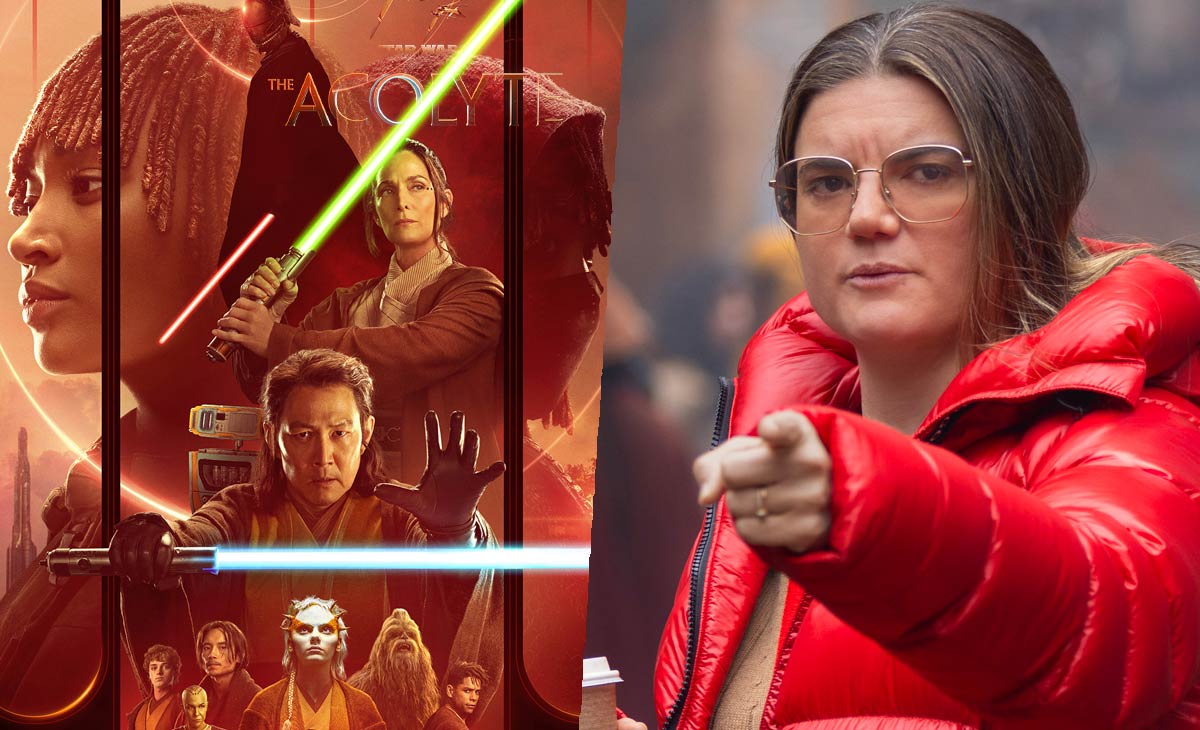
Some cancellations feel like ruptures — sudden, surgical, almost surreal. But for Leslye Headland, the demise of her “Star Wars” series, “The Acolyte,” landed less like a shockwave than a slow, inevitable fade-to-black. In an ecosystem where culture-war outrage has become a monetized blood sport, and studios are quietly retreating from the DEI commitments they trumpeted only a few years ago, Headland says she recognized the signals long before Lucasfilm made it official. “I remember thinking, ‘God, I wish it wasn’t coming out in an election year,’” she told The Wrap in an interview this week. “I started to feel it immediately.”
As a queer filmmaker whose collaborators primarily come from the same community, Headland says the shifting political headwinds weren’t theoretical — they were personal. “It contributed to the move away from DEI hires,” she said. “I just see the world through my specific lens, and that means doing different things.”
The reaction online was predictably ferocious, but Headland says she understood exactly how and why it escalated. “I was not online,” she noted, “however, I am a ‘Star Wars’ fan… I’ve always been part of the recap/criticism/lionization fandom community.” She speaks of that world with both affection and a sense of disillusionment. “There are channels I respect, and there are snake oil salesmen… and then, of course, there are the fascists and racists. It runs a gamut.”
But to Headland, the backlash wasn’t purely ideological — it was economic. “There’s a lot of money to be made,” she said of creators monetizing reaction videos, breakdowns, and outrage content. “The content being made about ‘Star Wars’ will ultimately be more culturally impactful than the actual ‘Star Wars.’”
When the cancellation came, she wasn’t stunned — only by its speed and the public nature of the announcement. “I was not surprised by [the cancellation]. I think I was surprised at the swiftness of it and the publicness of it,” she said. “I was surprised by how it was handled. But once I was getting particular phone calls about the reaction and the criticism and the viewership, I felt like ‘OK, the writing’s on the wall for sure.’” She added that metrics for Star Wars shows are uniquely brutal: “You’re measured against every other ‘Star Wars’ show.”
Despite the noise surrounding the show’s rollout, Headland still believes it never had the chance to reach the viewers it was actually built for. As she put it: “I feel like, for a launch of a first-season show that was trying different things, I think it could have been worth it to allow the audience it was meant for to find it. But that wasn’t up to me. So I fully respect the decision, even if I’m sad about it.”
Still, Headland says the risks were built into the DNA of the pitch from day one — and she never pretended otherwise.
“The whole thing with ‘The Acolyte’ was always a major risk,” she admitted. “It was a new part of the timeline. It was all new characters. It was a part of the lore where you couldn’t use a Stormtrooper… I also think that any gripes creatively with the show are completely valid… Like I said, the show was always a risk. It’s the old adage that the first one through the wall is the bloodiest. And this is very similar to coming back to your question about the company, it was just very much, ‘Let’s shoot for the sky.’”
She also revealed what Season 2 might have become. “We definitely were thinking about that, specifically with Manny Jacinto’s character,” she said. Lee Jung-jae was envisioned as the emotional core of the first season, but the creative team had already mapped out the thematic direction for a follow-up. While only “a couple of signposts” existed narratively, the emotional dynamics were already forming.
Even with the series now a casualty of the franchise’s shifting winds, Headland remains unwavering in her connection to the galaxy. “I’m absolutely obsessed with ‘Star Wars.’ I still am,” she said. “And I have no regrets.”

Rodrigo Perez is the founder and editor-in-chief of The Playlist, which he launched in 2007. He has worked in entertainment journalism since 2000, including at MTV, and has written for SPIN, IndieWire, Pitchfork, Complex, Magnet, and various music, film, and entertainment publications over the past two decades.
- Rodrigo Perez
- Rodrigo Perez
- Rodrigo Perez
- Rodrigo Perez
- Rodrigo Perez
- Rodrigo Perez
- Rodrigo Perez
- Rodrigo Perez
- Rodrigo Perez
- Rodrigo Perez

