


![Steven Soderbergh On ‘The Christophers,’ Legacy, Grievance And Why Ian McKellen’s Artist Character “Refused To Evolve” [Interview]](https://cdn.theplaylist.net/wp-content/uploads/2026/04/08132019/Steven-Soderbergh-On-%E2%80%98The-Christophers-Legacy-Grievance-And-Why-Ian-McKellens-Artist-Character-Refused-To-Evolve-Interview.jpg "Steven Soderbergh On ‘The Christophers,’ Legacy, Grievance And Why Ian McKellen’s Artist Character “Refused To Evolve” [Interview]")
Nostalgia is a deadly weapon. When I think of this quote, I often return to Steven Soderbergh, a filmmaker who is always restlessly moving forward like a shark. Sure, he evaluates, takes stock, and performs post-mortems, especially on failures to see what he can learn and apply to the next thing, but it’s always service of momentum, future goals, and never navel-gazing.
It’s with a sly irony then, or at least revealing commentary, that his latest film, the superbly witty and agile chamber drama, “The Christophers,” is largely about an artist who refused to evolve. Also centering on ideas of grievance, legacy, and the failures that threaten to define us if we cannot become unstuck from the past, the dramedy centers on Julian Sklar, a once-famous, now-embittered London painter and artist magnificently rendered by an acerbic Ian McKellen. In the film, written by one of Soderbergh’s constant creative companion Ed Solomon (“Mosaic,” “Full Circle,” “No Sudden Move”), Sklar’s estranged children, played by James Corden and Jessica Gunning, enlist a young painter and sometime forger, played by Michaela Coel, to steal—and finish—the crotchety artist’s series of famously unfinished canvases, so they can cash in on the inheritance they fear their father will deny them.
But then “The Christophers” almost immediately subverts the heist trope you’re expecting, morphing into something with much more depth; an incisive tête-à-tête between two artists grappling with defeats, bitterness, and some tough questions about artistic integrity (read our review here).
So, there’s a sharp meta-tension in the movie too. For a filmmaker who has spent decades refusing to harden—stylistically, professionally, even psychologically—“The Christophers” is a movie about an artist who checked out. But worse, he’s convinced himself he hasn’t. The result is a chamber piece about grievance, legacy, self-mythology, and the decay that sets in when nostalgia calcifies into identity.
The film had its world premiere in TIFF’s Special Presentations lineup last year and opens April 10 via NEON. Talking about the movie, Soderbergh kept circling the same pressure points that animate it: relevance, decline, self-awareness, the fear that your best work is behind you, and the temptation to confuse one good stretch with permanent truth. Those anxieties are all over Julian, but they also opened the door to a broader conversation about artists, audiences, and the danger of getting trapped inside your own grievance narrative.
In his conversation, Soderbergh also discusses why Julian Sklar “refused to evolve,” how the film became a “cross-generational platonic rom-com,” the subtle handheld rule inside Julian’s house, and why McKellen felt like a performer drawing on everything he had ever done.
Why did Julian’s nostalgia and grievance feel like the right engine for this story?
He’s not only stuck in a fantasized version of his own past, but he’s also blaming other people for his self-inflicted exile from the art world and from popular culture. The bottom line is, he refused to evolve and got frozen in a moment of his success. That tends to happen more often with young artists. It’s something I talk with young filmmakers about—avoiding being stuck in the moment of your first success, because there’s this potential pitfall of thinking, “Okay, so that worked. I just need to keep doing that.”
And that won’t work over time. It may work for a while, but it won’t work in the long term. He refuses to see his decline as anything other than other people turning on him, and insists that it has nothing to do with the fact that his work was in decline. He wasn’t seeing himself clearly, he wasn’t seeing his work clearly, and he decided, “It’s not me, it’s them.”
What’s fun about the movie is that if it weren’t for [Michaela Coel’s character] showing up under very dubious circumstances, he would still be stuck there.
Did that connect to your own resistance to repeating yourself?
You can read interviews with me from Sundance in 1989. I’m already saying I hope people don’t expect me to make this movie [“Sex, Lies, and Videotape”] over and over again. I had the luxury of making five films in a row that nobody saw. You can’t do that anymore. You would be in movie jail, and you wouldn’t be getting opportunities. I needed those five movies to get to “Out of Sight.”
There are times when most people go through periods of wondering whether the talent or skills they have are going to disappear or are already diminishing. You get a group of filmmakers together for any length of time, and this is what gives them the night sweats—the idea that their best days are behind them.
Occasionally, you have to remind yourself not to panic, and that in gut-check moments in the past, you were able to maintain your composure and, to use a sports analogy, to play free. When people ask, “What’s your favorite thing?” I say, “The next one.” It’s very rare that you look back at something and say to yourself, “I wouldn’t change anything.” “Out of Sight” is one of them. But that’s rare, and so every new thing is an opportunity to get it right—or get it better.
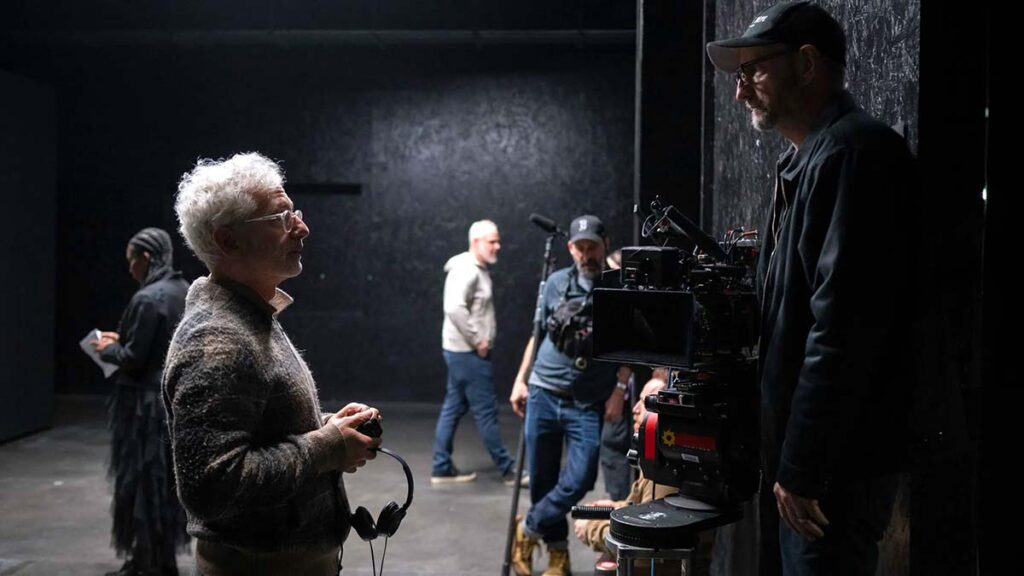
You generated this one initially. What was the idea you took to screenwriter Ed Solomon, and what did that unlock?
It started as me pitching Ed a one-sentence idea: aging artist comes into contact with a young assistant who’s there under somewhat nefarious circumstances, and that was kind of it. Packed within that already are these issues of legacy and relevance. You’d rather make something that people actively hate than something that people shrug at.
Ed and I were both interested in this idea of what are you leaving behind? What is going to be the historical read on the work that you’ve left behind? Not that you should be thinking about that while you’re working, but you would hope it would be viewed as being rewatchable. That’s kind of the best you can hope for.
We both really liked this idea of a bitter, backward-looking artist with a very well-developed, deeply embedded grievance narrative, and whether it would be possible to turn him around. And that’s all I gave him. It turned out not only did Ed know a lot of artists—his mother actually painted her whole life—but he also knew some older artists who he felt were very close to Julian in their feeling of having been passed by and, more importantly, that all of the work that’s considered good since they were considered good sucks. The other component is that not only have I been left behind, but all this new shit is terrible.
How much were you thinking about empathy, our current grievance culture, and the generational divide?
It’s really hard because of the way we’re wired not to extrapolate our personal experience into a larger collective experience that should be the nodal point for everyone else. Understandably, we try to imagine what it’s like to be another person. But the fact remains that another person is ultimately unknowable at a very basic level.
I’m lucky in that I’m okay with that mystery, I’m okay with that uncertainty. I feel it’s probably not a bad thing that I can’t tell what everybody’s thinking all the time. But especially if you’re working in the creative space, it can be frustrating. It’s kind of a philosophical, sociological version of the last ten feet problem. You can know somebody really, really, really well and still not know them.
Art is a way to represent the unknowable part of yourself to others. It’s better than just a story about yourself. I’d rather somebody watch something I’ve made than listen to me talk about myself.
And I really liked the fact that you’ve got a multiple-generation gap here. It’s this weird cross-generational platonic rom-com in which, in classic comedy fashion, you look at the two of them in the same room and think, how are they ever going to connect? But what ultimately binds them is that, as difficult as Julian is and reprehensible in some ways, he’s not a liar.
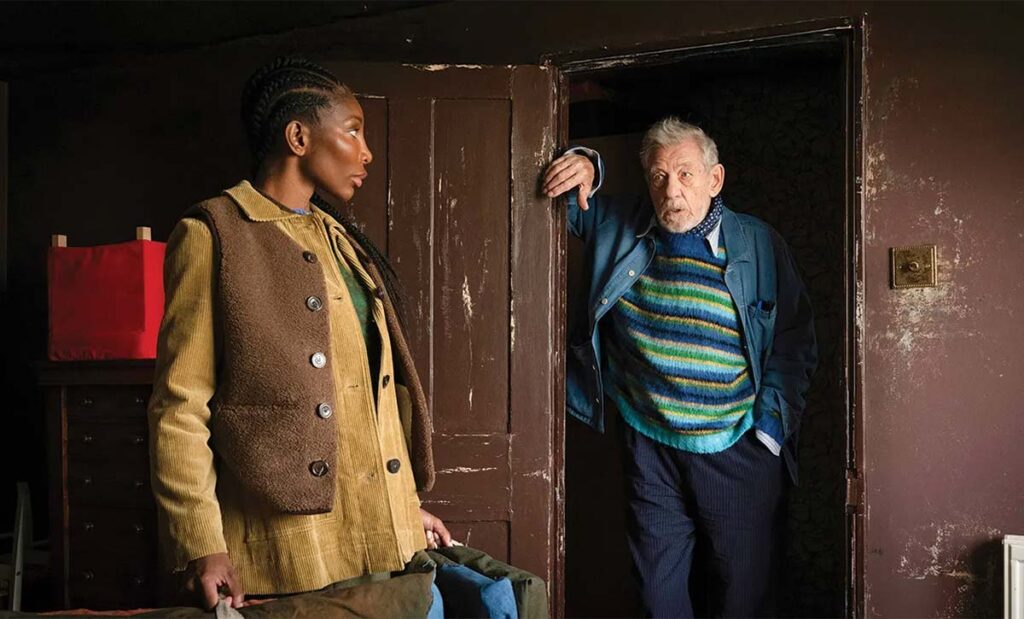
What did Ed Solomon change once he started building the script out?
What Ed did that I was really happy about is that my version of it wasn’t as emotional, wasn’t as warm, ultimately, wasn’t as philosophically complex. It was much more, in my original imagination, a kind of Patricia Highsmith, Tom Ripley movie.
Ed filled it out and made it something deeper and better. I didn’t have the family element. He built all of that. It was much more of a noir movie than what we ended up with, as I was describing it to him. But I was really, really happy when it came back that he made it more real, ultimately, and I think that was a great idea.
How did you visually, or even philosophically, approach the film’s tight, claustrophobic space?
I had to lean into that, because it was really built that way, and it’s part of the point—he won’t leave. When, at the end, [McKellen’s character] goes outside to see [Coel’s], that’s a huge deal, and his whole affect is different. You can tell he’s not as armored as he is when he’s at home.
I made my career on people in rooms talking, so that wasn’t scary to me. But I did have to come up with some strategies to make sure that it wasn’t boring. One of those was the idea that as soon as you cross the threshold of his house, we’re handheld. If you’re outside the door plane, you’re in studio mode, but as soon as you cross that threshold, the camera’s on the shoulder, which creates a subtle destabilizing feeling.
Even to the point when she goes back, after he’s no longer here, and she’s inside the house, we’re in studio mode, because he’s gone. [Peter Yates’ 1983 film] “The Dresser” is one of my favorite movies, and I thought about that a lot, that kind of two-hander.
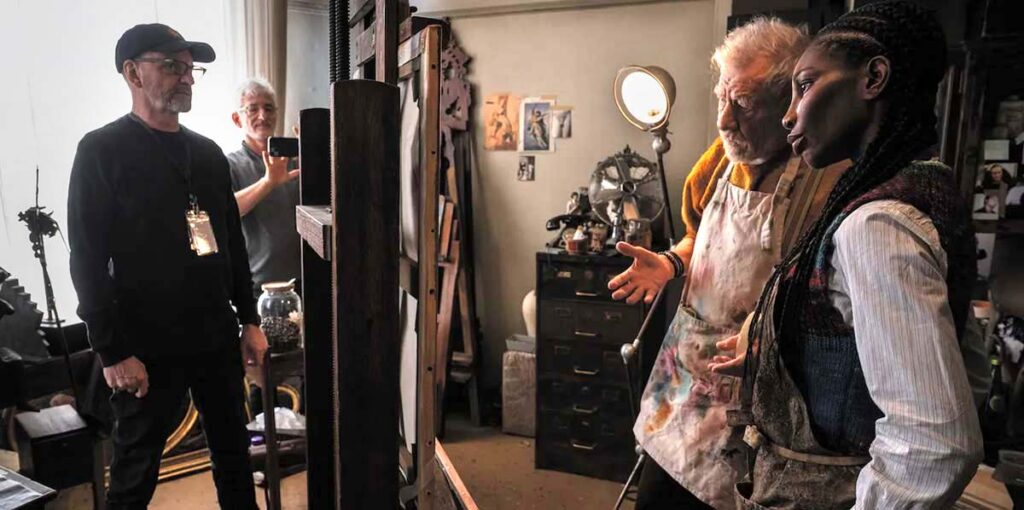
What did Ian McKellen and Michaela Coel give you once they were in the movie?
Once we got Ian and Michaela, I wasn’t really worried about any of that, because the two of them in a frame was just so interesting.
Ian is such a unique presence; he’s hard to write movie lead characters for because he’s just totally unique and not a typical male lead actor. I feel like people have had difficulty finding a place for him in movies, and this felt like it was drawing upon everything he’d ever done.
What’s interesting is that, having spent a certain amount of time with him, he’s so not like Julian. When I watch the movie, honestly, I don’t see Ian. To me, Ian is a very different person from Julian. And yet he’s drawing on sixty-plus years of work to kind of spin this web that pulls you in. It was really, really fun to watch.
He also appreciated the simplicity and the efficiency of the way that we like to work. It’s very simple. There are very few people around. I’m operating the A camera. We usually have more than one camera going. It’s mostly available light. He loved all of that—show up on set, start shooting, and just keep shooting until the day is finished. He was so excited about the immediacy of that process.
“The Christophers” opens this Friday, April 10, via Neon.
This interview was lightly condensed for clarity, and so long that we’ll break it up into at least one more part.

Born in Chile, raised in Canada, now living in Brooklyn, NY, Rodrigo Perez is the founder and editor-in-chief of The Playlist, which he launched in 2007. He has worked in entertainment journalism since 2000, including at MTV, and has written for SPIN, IndieWire, Pitchfork, Complex, Magnet, MuchMusic, and various music, film, and entertainment publications over the past two decades.

