


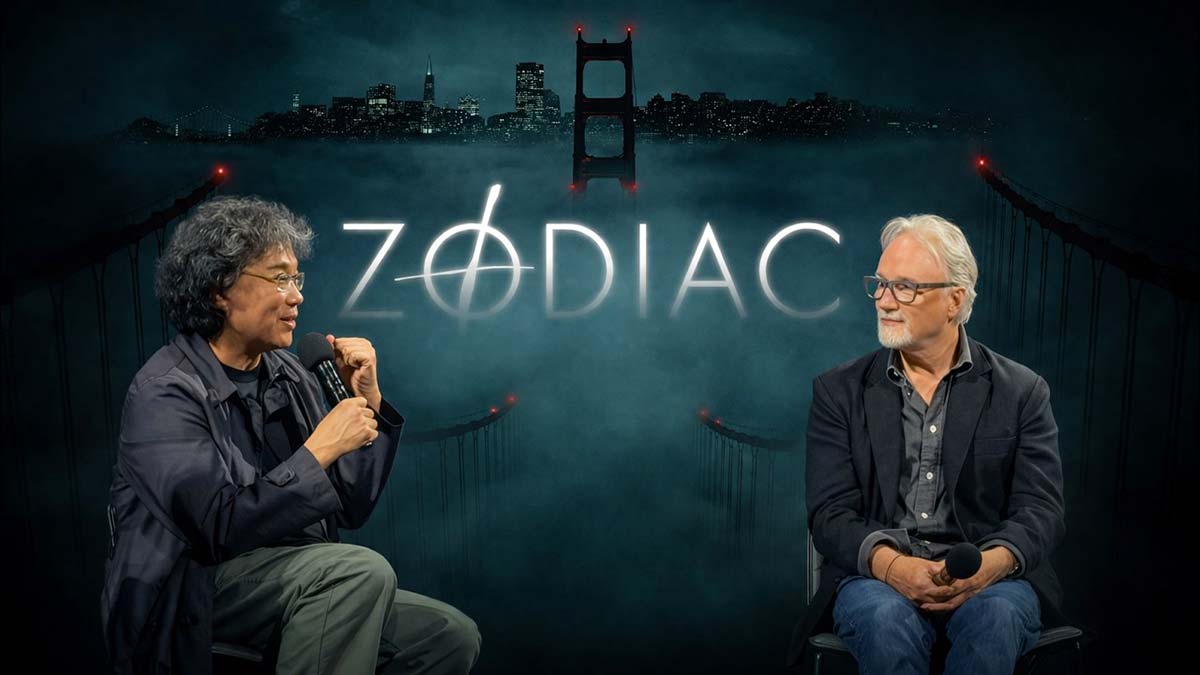
Very few crime movies get more revered with age. David Fincher’s 2007 thriller “Zodiac,” written by James Vanderbilt and following the way the Zodiac killer case pulls inspectors, reporters, and cartoonist Robert Graysmith into a years-long spiral of obsession, did. With Jake Gyllenhaal, Mark Ruffalo, and Robert Downey Jr. anchoring that descent, the film opened as a chilly, meticulous procedural and has kept growing in stature over the years, less because it offered closure than because it turned uncertainty, fixation, and spiritual erosion into the point. So it made perfect sense that Bong Joon Ho would be the filmmaker hosting a 4K screening at the Academy Museum of Motion Pictures and a post-film conversation with Fincher recently as part of the museum’s “A Weekend With Bong Joon Ho” series.
Bong made that admiration plain right away. After recalling how immaculate Fincher’s office was—even down to the colored pencils arranged by shade—he got to the question underneath that story: whether Fincher’s obsessiveness really matched its reputation. Fincher did not deny it. If anything, he leaned into it, saying, “No, I mean… Look, I feel like you should do everything in your power to be as clear in what you’re trying to communicate as you can possibly be.”
That led directly into what “Zodiac” was built to do. Bong contrasted it with “Seven,” pointing out how quiet and restrained “Zodiac” feels for a serial-killer picture. Fincher answered by drawing a line between the two films. “We weren’t making a movie about a serial killer,” he explained. We were making a movie about the effects of a serial killer on a community and on the lives of people, some of whom probably shouldn’t have taken an interest.” Then he sharpened the point even further. “This movie is much more about the accretion of hopelessness,” he said. Fincher also talked about his own memory of the case from childhood in Marin County, calling the Zodiac “the boogeyman” of that period and recalling a conversation with his father that later found its way into the film.
Bong also brought up the kind of story that has followed Fincher for years: an actor doing take after take, expecting a performance note, only to watch the director walk past and adjust something in the frame. Fincher did not dispute that one either. “More than half the gig is making sure that there isn’t something that’s distracting people from what they’re supposed to be looking at,” he said. “And so, if you have somebody who is given a hell of a performance, deep, but it happens to look like their hands are coming out of someone’s ear, you’ve got to go, ‘Dude, [move] 18 inches.’” Bong said the actor later asked what Fincher thought of the acting. Fincher’s reply: “Great,” he said succinctly, pausing for audience laughter. “Well, it was.”
The conversation turned more reflective when Bong asked what Fincher saw when he looked back at “Zodiac” now. Fincher did not talk about it as a settled achievement. Instead, he framed it as something that keeps shifting in his head as time passes and experience piles up. “You meet so many people in 20 years,” he said. “You have an idea about what a characterization should be in order for it to be truthful and read quickly, and you tend to make snap judgments, a lot of pressure. I look at it now, and there’s a lot of stuff I’m very happy with, but there’s a lot of stuff that I go, ‘Maybe it should be allowed to breathe over here,’ or ‘Maybe it would be should have been weirder,’ you know.” Fincher then took the same idea even further, saying he would do “everything differently” and that he was “almost always” in the camp of, “It should have been weirder.”
Bong followed by asking if there were shots he would now remove or add. Fincher’s answer widened beyond “Zodiac” itself. He said films are “a byproduct of their time,” argued that you try to preserve “the integrity of the intent,” and then leave the work alone. He also called a movie “a document of its era, of its time,” even while admitting that if he were remaking it from scratch, he would probably make different decisions all over again.
Bong also made a brief detour to Fincher’s next feature, Netflix’s “The Adventures Of Cliff Booth,” the “Once Upon A Time In Hollywood” follow-up that brings back Brad Pitt’s Cliff Booth from a script by Quentin Tarantino. As The Playlist previously reported, the package is a major one for the streamer, with a reported $200 million budget and roughly $80 million in above-the-line fees. Asked whether the film was a sequel, a spinoff, or something else, Fincher first narrowed it to the character, then said, “It’s where Cliff ended up six years, seven years later.” He continued, “Interestingly enough, I love [the character] Cliff Booth. I love him in that movie. He doesn’t say a lot. And now he has a much different job in this one, because he’s orchestrating a lot. But, yeah, I hope there are some very big surprises.”
That was about as much as Fincher gave away about Cliff Booth, but it was enough to make the aside memorable. The rest of the evening stayed with “Zodiac” and the choices inside it: why the film is so restrained, why the frame matters as much as the performance, and why a movie can keep changing in the mind of the person who made it long after the audience has turned it into a classic. Watch the Q&A below.

Rodrigo Perez is the founder and editor-in-chief of The Playlist, which he launched in 2008. He has worked in entertainment journalism since 2000, including at MTV, and has written for SPIN, IndieWire, Pitchfork, Complex, Magnet, and various music, film, and entertainment publications over the past two decades.

