


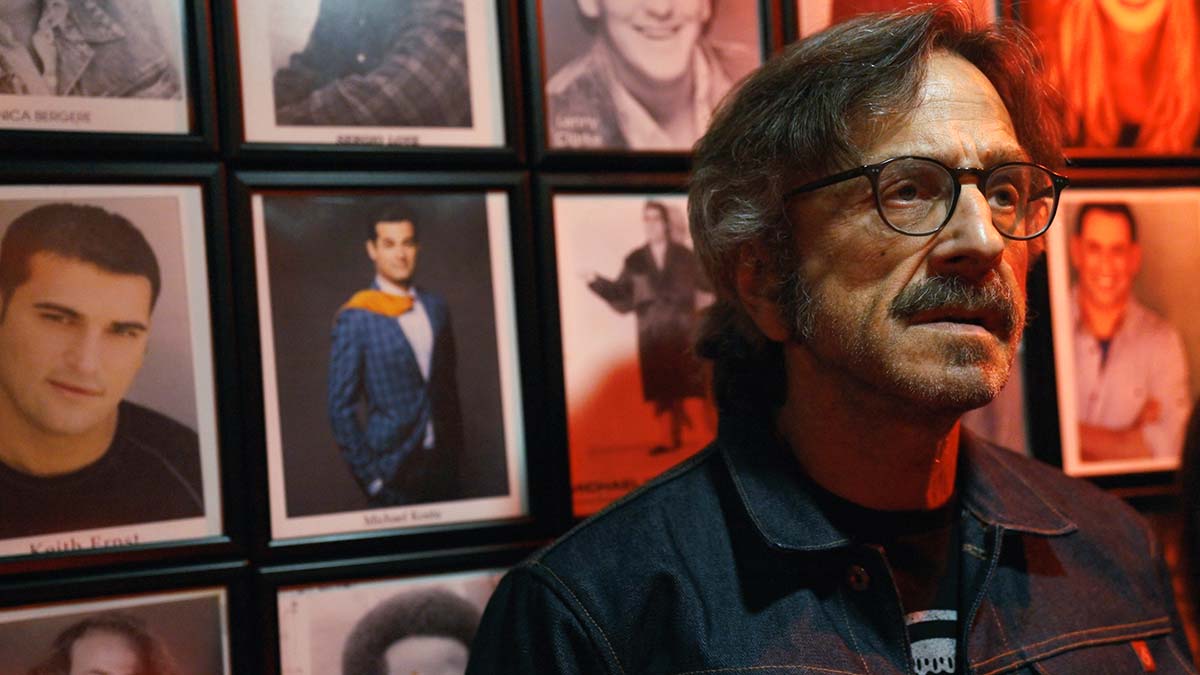
Marc Maron has always worn his neuroses and resentments on his sleeve. Still, the great irony of “Are We Good?” is how a documentary about a man once defined by bitterness blooms into something unexpectedly tender. Directed by Steven Feinartz, best known for chronicling comedians with raw intimacy in works like Maron’s HBO special “From Bleak to Dark,” the film begins like a straightforward career retrospective before unfolding into an emotional excavation of loss, identity, and reinvention.
READ MORE: Fall Film 2025 Preview: 61 Movies To Watch
The anchor is the sudden death of Maron’s partner, filmmaker Lynn Shelton, in 2020. Shelton had urged Maron toward kindness, vulnerability, and generosity; her absence forced him to reckon with whether those qualities could survive without her. The film shows him weaving her memory into his stand-up, mining dark laughs from pitch-black moments, and offering hurting audiences a kind of solidarity. The performances are jagged and uncomfortable at times, but they shimmer with authenticity, a testament to Maron’s conviction that grief can be both unbearable and comic.
Feinartz assembles a chorus of talking heads who sketch the man behind the mic. Nate Bargatze, John Mulaney, David Cross, W. Kamau Bell, Michaela Watkins, Laurie Kilmartin, Gary Gulman, Jessica Kirson, Caroline Rhea, and writer Sam Lipsyte reflect on Maron’s contradictions—how he could be both combative and generous, ruthless in self-laceration yet deeply empathic. They underline how his authenticity, once a liability, became his greatest currency as audiences sought something truer than polish.
The documentary revisits the rise of the “WTF” podcast, which rescued Maron from career stagnation and transformed bitterness into communion. His candid interviews with fellow comics and cultural figures revealed envy, admiration, resentment, and forgiveness. “Are We Good?” positions “WTF” as the crucible where Maron learned that self-acceptance was inseparable from connection—that to love others, he first had to learn how to stop despising himself.
For all its melancholy, the film is also surprisingly funny. Maron’s stand-up remains laced with self-deprecating humor, which cuts just as deep as it consoles. He finds unexpected punchlines in bleak confessions, turning tragedy into a communal release valve. There’s even room for flashes of anger at our current political climate—though not as much as one might expect from a comic who once bristled at every headline. The balance feels right: grief never suffocates the comedy, and comedy never trivializes the grief.
Formally, the film isn’t flawless. The comedy-club footage is dim and poorly lit, often obscuring expressions in a way that undercuts intimacy. Some animated reconstructions of Maron’s past feel more distancing than illuminating. But these missteps matter less as the emotional weight gathers momentum. In fact, the scrappiness mirrors Maron’s own trajectory: imperfect, jagged, raw, but ultimately resonant.
At its core, the film circles a single question: could Maron truly love himself enough to love others? The tension runs through his best comedy and most painful reckonings. Feinartz doesn’t pretend to resolve it; instead, he watches Maron wrestle, relapse into anger, reach for connection, and keep showing up. The answer is never fixed, but the effort itself becomes moving.
By the end, “Are We Good?” transcends its conventional biographical trappings to land somewhere soulful. Dragging us through the wreckage of grief and out the other side, it suggests that Maron’s legacy isn’t merely acerbic stand-up or podcast milestones, but the more complex work of becoming human in public. His comedy has always thrived on blunt honesty; here, honesty is reframed as survival. In honoring Shelton and revealing his bruised heart, Maron gives us something comedy rarely offers: a roadmap through despair that refuses false consolation. [B]

Rodrigo Perez is the founder and editor-in-chief of The Playlist, which he launched in 2008. He has worked in entertainment journalism since 2000, including at MTV, and has written for SPIN, IndieWire, Pitchfork, Complex, Magnet, and various music, film, and entertainment publications over the past two decades.
- Rodrigo Perez
- Rodrigo Perez
- Rodrigo Perez
- Rodrigo Perez
- Rodrigo Perez
- Rodrigo Perez
- Rodrigo Perez
- Rodrigo Perez
- Rodrigo Perez
- Rodrigo Perez

