


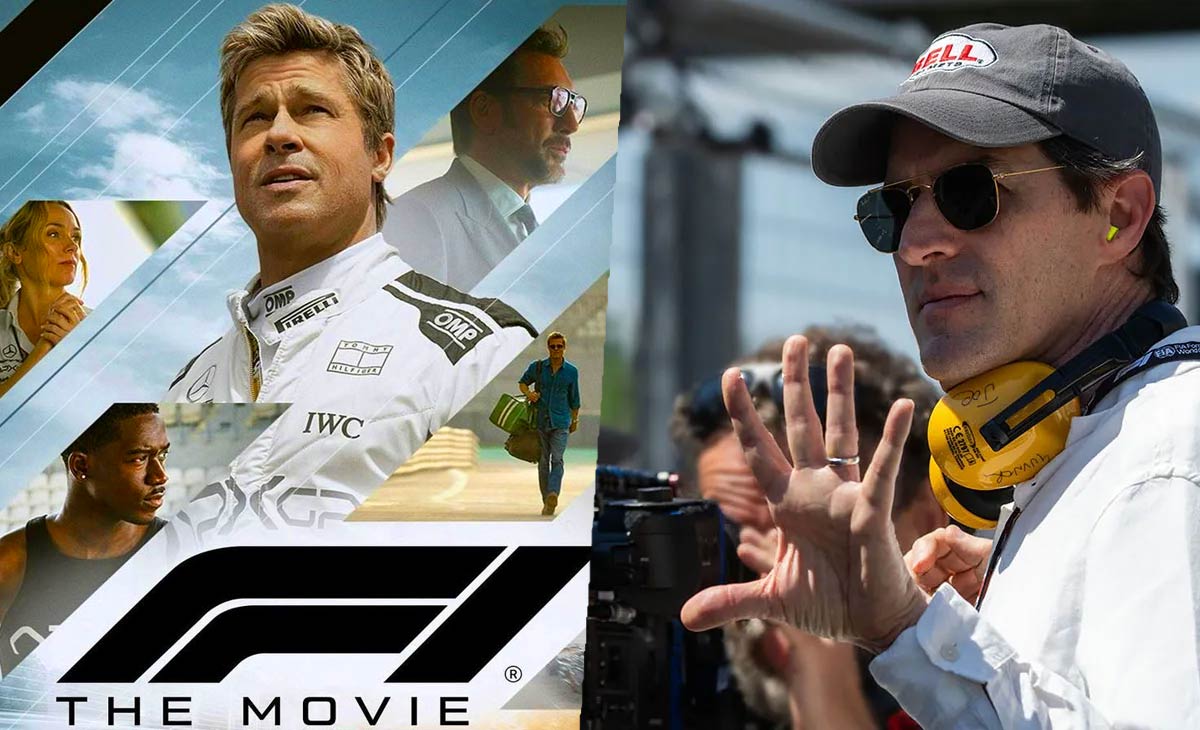
Filmmaker Joseph Kosinski’s “F1,” starring Brad Pitt, is off to the races at the box office this weekend. The movie is exceeding expectations and zooming towards a $140 million-plus global opening weekend.
Starring Pitt and Damson Idris (“Snowfall”), the film centers on a former almost-was racing champion (Pitt) turned nomadic racer-for-hire who’s convinced by an old friend (Javier Bardem) to enter Formula One for one last shot at saving his friend’s team and being the best in the world. The veteran, however, is forced to drive alongside the team’s hotshot rookie (Idris), intent on leading the pack. What ensues is an action-packed, thrilling and captivating racing drama that plays like a big stadium concert.
Kosinski famously watched the addictive” Formula 1: Drive to Survive” Netflix documentary series during the pandemic and got hooked on the sport. As thrilling as much of it was, the filmmaker said the most captivating part of the series was watching losing teams and how they responded to their many challenges and the inter-team rivalries.
“Formula is an incredibly unique sport in that your teammate is also your, in many ways, your greatest competition. And for me, that makes for a great drama,” Kosinski explained.” I also loved how the show’s first season focused on the last-place teams, the underdogs, rather than teams at the front of the pack. And I thought that there was an interesting story to be told about an underdog team—not really trying to win the championship, per se, but just trying to win one race against these titans of the sport.”
Authenticity is a considerable element of Kosinski’s films—the director uses that as the foundation to lift off from, even if he’s telling a science fiction story or something fantastical, grounding the movie in some kind of reality, creates tension, stakes and a realness you can’t fake. Ultimately, the film’s actors were always driving in the cars.
“Every time you see Brad or Damson driving in this movie, they’re driving on their own in one of these real race cars on a real F1 track,” he said., “That’s kind of how we approached the making of this film.
For Kosinski, that need for authenticity made him reach out to world-class Formula One driver Lewis Hamilton, who became a producer on the film and briefly appears within.
“In order to get Brad and Damson into these race cars for the filming, it required months, literally months of training,” Kosinski explained. “I’ll never forget having Lewis Hamilton as your driving instructor, but what we learned and what Lewis was really interested in was seeing whether Brad knew how to drive right? Because if Brad can’t drive, this whole film wouldn’t work. And Lewis was pleased to discover that Brad had a lot of just natural ability right from the start.”
“I don’t know where he got that or if he was born with it, and he rides motorcycles, which I think has something to do with it, but he’s just a very talented, naturally gifted driver,” he continued. And for Lewis, that first meeting—watching Brad drive— gave him a lot of confidence that we might have a shot at pulling this off.”
“F1” was made with the participation of the entire Formula One industrial complex, which meant shooting during the middle of real races, while crowds, but at times, windows where the film crews would have to execute with little more than one or two takes flawlessly. This meant an enormous amount of prep.
“I mean, on ‘Top Gun: Maverick,’ working with the Navy in a similar capacity, it wasn’t entirely different, and we prepped like crazy too, all this training to make sure the actors could endure the G-Force and all of the intensities of flying, but this was maybe another level in terms of crew, orchestration and shot preparation,” he explained. “But yet, Formula One buy-in was essential.”
Cruise was one of the key producers on “Top Gun: Maverick,” and Pitt was a chief producer on “F1.” Asked how the two actor/producer styles are distinguished from one another, Kosinski said they were surprisingly more alike than different.
“You know, they’re alike in many ways,” Kosinski said. “They’re at the top of their game, and have been for many decades for a reason. They’re leaders, they excel, and they strive for excellence and lift up everyone around them in doing so. It’s what great athletes do who are team leaders, they lead by example with great attitude, drive and presence that’s meant to inspire.”
READ MORE: Summer 2025 Movie Preview: 50 Films To Watch
Up next for Kosinski. Well, that’s up in the air. Kosinski said three of his movies—“Top Gun 3,” an untitled UFO movie, and a “Miami Vice” remake– were in the works and in active development, and he’s not sure which one will go next.
While he remained tight-lipped about them all, he opened up a bit when we told him we had spoken to screenwriter Dan Gilroy—currently penning the “Miami Vice” movie—who admitted the original TV series was quite the inspiration.
“Yeah, we’ve looked at the original series quite a bit, that’s a fun era, and you can’t go wrong with Michael Mann,” he said. “Some of those directors on the series are particularly unsung, too. Someone like Paul Michael Glaser did some terrific work.”
Asked if we would have to wait another thirty years for “Top Gun 3,” Kosinski chuckled and said no.
“Ha, yeah, no, Tom, despite the way he defies age and gravity, I think he might want to skip it by then,” he laughed. “Ehren [Kruger] ’s writing it, we’re working on it, we have an idea we like, so we’ll see, and hopefully, it will come together soon.”
Asked what he hopes audiences walk away from when seeing “F1,” again, for Kosinski, it was the raw authenticity shown on screen.
“You have to be fearless,” he said. “And when you see Brad driving, that’s not acting— he’s deeply concentrating on keeping that car on the track and off the wall during all those scenes. That’s something you can’t fake, and I hope the audience feels that when they watch the movie.”
“F1” is in theaters now via Apple Original Films and Warner Bros.

Rodrigo Perez is the founder and editor-in-chief of The Playlist, which he launched in 2008. He has worked in entertainment journalism since 2000, including at MTV, and has written for SPIN, IndieWire, Pitchfork, Complex, Magnet, and various music, film, and entertainment publications over the past two decades.

