


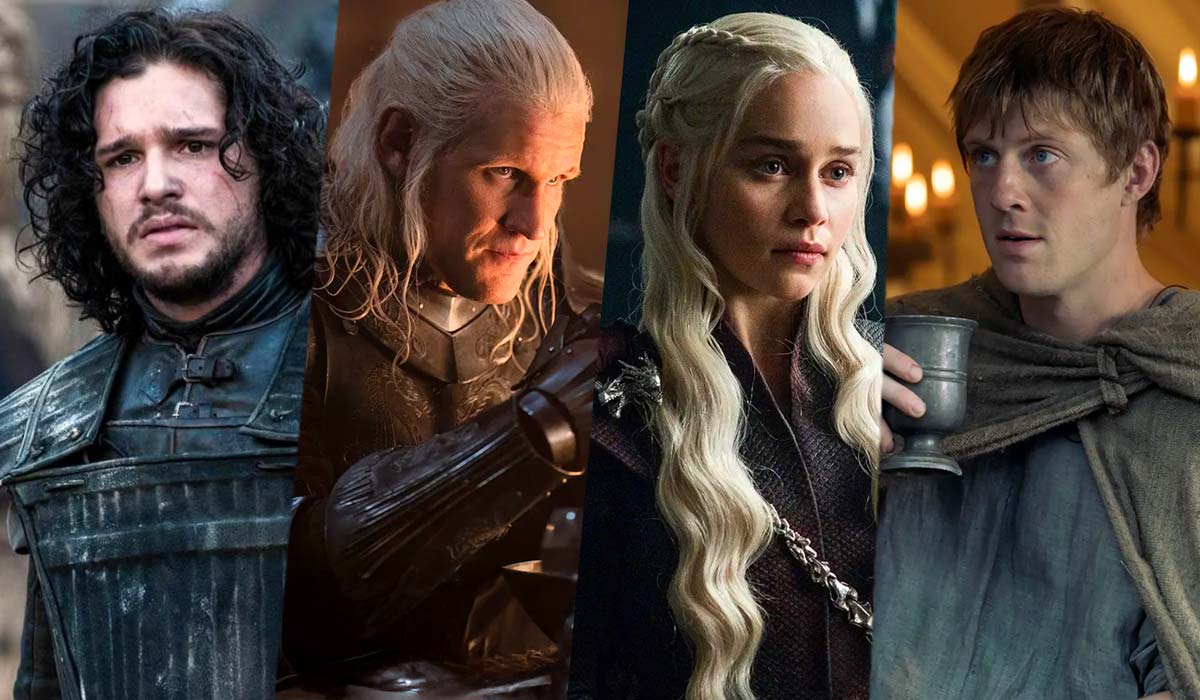
Revitalized talk of a “Game Of Thrones” spinoff series centered on Kit Harinton’s Jon Snow character—reportedly back in very early development and potentially expanding to include Arya Stark (Maisie Williams)—has predictably rekindled the fandom’s most combustible engine: rumor-as-fuel, speculation-as-oxygen, and a desperate hunger for any official sign that Westeros is about to reopen for business. But if you’re waiting for HBO’s Casey Bloys to start feeding that machine with a neat, Marvel-style roadmap, don’t hold your breath.
In a recent Deadline interview, pressed on the revived Jon Snow chatter—and the way fans and headlines keep trying to will a sequel into existence—Bloys defaulted to HBO’s usual development tight-lips stance. Still, they couldn’t resist correcting the record on what’s actually made it to air, so far.
“Well, since you’re asking, you know what my answer is going to be, which is that we don’t really talk about development,” he insisted when asked about the Jon Snow-Arya Stark sequel. “But, one thing I will say…Obviously, there’s a lot of interest around the ‘Game of Thrones’ universe. And I do like to remind people that there have been exactly two spinoffs: ‘House of the Dragon,’ and then ‘The Seven Kingdoms,’ which launched two weeks ago.”
As spinoff chatter swirls and every new rumor gets treated like a countdown clock, Bloys tried to draw a clean line between what HBO toys with behind closed doors and what actually makes it onto the schedule, arguing the franchise conversation has blurred “development” into something far more concrete.
“Sometimes, because of the intense interest in development, I think people get confused and believe that development means something is actually in production,” he explained. “So I just want to be clear about that we’ve been very, very judicious about shows that we produce. We’ll develop a lot because we want to give ourselves the best chance of finding a show that makes sense, but we have not produced all that much.”
Trying to tamp down the idea that Westeros is headed for an endless franchise treadmill, Bloys stressed HBO isn’t operating on a rapid-fire IP cadence, while maybe delivering a slight dig at the oversaturation that some superhero studios offered in the last half-decade.
“This is not Marvel level, four series a year, or anything like that,” he said adamantly. “So sometimes people confuse development speculation with actual shows being produced.”
Trying to pin him and ask how many live-action and animated offshoots are still active and whether anything is nearing a greenlight, Bloys wouldn’t bite. His rationale is basically the headline again, stated with slightly more irritation.
“I’m not getting into any of that. Development is development; we like to give ourselves as many options as possible,” Bloys remarked. “And that’s part of the reason why it makes no sense for us to comment on it, because it does fuel this idea that misinformation, and shows are about to be greenlit, and so we just try to keep a lid on it. I know it all comes from the place of being excited, but we try to be careful about what we actually develop and produce.”
Asked if “A Knight of the Seven Kingdoms” could broaden the franchise’s storytelling palette beyond dragon-sized spectacle, Bloys pointed to it as proof the audience will follow Westeros at any scale.
“I do think that ‘A Knight of the Seven Kingdoms’ was instructive in that it does show that the interest in the ‘Game of Thrones’ universe is there, whether it is huge set pieces or more intimate character pieces,” he said. “So that was instructive. But the way we develop is from the stories. And like I said, from the beginning, George [R.R. Martin’s] conception of the ‘Dunk and Egg’ novellas was on a small scale. So I don’t think I would take what would otherwise be a giant show and try to produce it smaller. The creative has to lead.”
Speaking of George R.R. Martin, the occasional public friction around “House of the Dragon” bubbled up again when Bloys was asked about the latest fracas — Martin openly airing his deeply strained relationship with “House of the Dragon” showrunner Ryan Condal. Even so, the HBO chief framed it as messy-but-manageable family business rather than anything resembling an existential rupture.
“Like any good American family, I would prefer that our dysfunction stays behind closed doors,” he began. “But here we are. What I would say is George introduced us to Ryan Dombal as the person that he thought would be the best to create ‘House the Dragon.’ And I will say Ryan has been an excellent showrunner and a really great partner and collaborator, so we embrace his vision and his creative choices, or we wouldn’t have done it.”
And while Bloys didn’t pretend everyone’s going to share the same creative instincts on every turn, he also underscored why Martin remains impossible to sideline in the bigger “Game of Thrones” ecosystem.
“I consider it great to have George as the architect of this world,” he stated plainly. “I mean, think about what he has created, the world, the families, the battles, all of the history, it’s pretty extraordinary. George is a great partner for us to have. The idea that he is going to agree with every creator or showrunner that is either developing or producing, two artists are not always going to agree. So, some of this comes with the territory.”
At bottom, Bloys is trying to keep Westeros from turning into a content treadmill: development isn’t a promise, output won’t spike to Marvel extremes, and any future offshoot only happens if the story earns it. And even when the creative family drama leaks into the open, HBO’s message is clear—George R.R. Martin remains too central to the franchise to be anything but part of it.

Rodrigo Perez is the founder and editor-in-chief of The Playlist, which he launched in 2008. He has worked in entertainment journalism since 2000, including at MTV, and has written for SPIN, IndieWire, Pitchfork, Complex, Magnet, and various music, film, and entertainment publications over the past two decades.

