



After doubting him at their own peril, the conventional Hollywood wisdom is now to never bet against writer/director James Cameron. Skeptics foretold doom for the filmmaker with the wildly expensive “Titanic,” only for him to create the biggest movie in the world at that time. More than a decade later, pundits thought he would finally flop with “Avatar,” only for Cameron to game-change cinema again with fantastical 3D and eye-popping performance-capture visuals.
READ MORE: The 150 Most Anticipated Films Of 2026
Three for three in the last thirty years — “Titanic” and both “Avatar” films — Cameron has made a career out of turning hubris into box-office gospel. But with his latest entry in the saga, “Avatar: Fire & Ash,” the storytelling limits finally outweigh the ambition. The movie succumbs to more of the same, without the thrill of a new milieu, like the oceanic Pandora of “Avatar: The Way Of Water,” to provoke genuine awe and wonder.
Or rather, there are plenty of underwater sequences here, replete with epic grandeur and radiant bioluminescent marvel. The problem is we’ve seen it all before, literally and figuratively. Cameron recently admitted that his second “Avatar” chapter was so big he split it into two movies — “The Way Of Water” and “Fire & Ash” — and you feel that decision in every frame. The new film plays less like a standalone third installment and more like “The Way Of Water: Part 2,” an overextended continuation that never really justifies its own existence. For all his flaws, arrogance and love of the hyperbolic, Cameron has always insisted that spectacle means nothing without heart, soul, story and feeling. And while true, he doesn’t really heed his own advice in the latest chapter.

Cameron has never been a particularly brilliant screenwriter—emotively and conceptually, absolutely, words, not so much— and the weak dialogue of “Fire & Ash” is easily the franchise’s most risible and unintentionally funny drivel. Still, he’s usually managed to get by on sturdy melodrama, emotional character stakes and an almost primal grasp of archetypal storytelling. Combined with dazzling visuals and a monumental sense of scale, the “Avatar” films have always been flawed but undeniable, eminently watchable crowd-pleasers. “Fire & Ash,” however, commits the cardinal sin of having nothing new to say, offering no truly novel challenges for its protagonists and recycling most of the clever ideas from “The Way Of Water” to rapidly diminishing returns.
Story-wise, “Fire & Ash” is thin. Even the baked-in theme of grief and overcoming loss is quickly sidelined in favor of a middling war plot. The ideas about accepting outsiders are fairly pedestrian, and the notion of indigenous clans being duped into doing the bidding of colonizers—while interesting in concept— isn’t handled with any convincing complexity. It’s all there in theory, but rarely dramatized with much nuance.
Plot-wise, the movie picks up in the immediate wake of “The Way Of Water.” The Sully family is mourning the loss of their eldest son, Neteyam (Jamie Flatters), and the Metkayina Oceanic clan is celebrating their victory against the interloping “Sky People.” But this triumph is short-lived. Jake Sully (Sam Worthington) knows Pandora’s aggressive Resources Development Administration (RDA) will inevitably return in greater numbers and with heavier firepower, and he’s not wrong. Unfortunately, “Avatar: Greater Numbers and Heavier Firepower” is pretty much the movie.
Having lost her son, Neytiri (Zoe Saldaña) is still inconsolable, her grief manifesting as barely contained rage, often directed at the feral, Na’vi-wannabe human teenager Miles “Spider” Socorro (Jack Champion), whom she has never accepted. Clunkily, the plot is jump-started by a crisis with Spider’s oxygen-breathing apparatus, which is running out. Jake makes the tough call to send him to stay with Dr. Norm Spellman (Joel David Moore) and the rogue Pandoran Research Foundation (ex-RDA human scientists operating on their own), and this escort mission nudges the story into its next location.
On their journey, the Sullys and Spider join Peylak (David Thewlis), Na’vi leader of the Wind Traders, ostensibly to safeguard against the Mangkwan clan — a volcano-dwelling Ash tribe whose aggression is the stuff of Pandora legend. Sure enough, the Mangkwan raid is carried out with vicious force, scattering the Sully family, and the narrative finally kicks into gear.
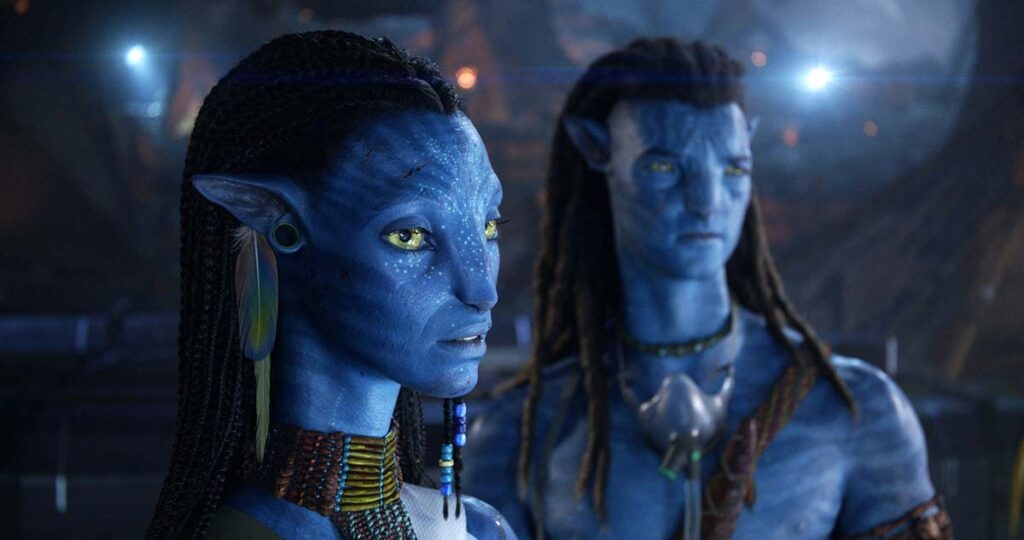
Eventually, Mangkwan leader Varang (Oona Chaplin) allies with Quaritch (Stephen Lang), the resurrected recombinant Na’vi version of the original human villain, and his thuggish squad of Na’vi soldiers. But beyond this escalation, there isn’t much story: the conflict on Pandora simply continues to scale up and out. Sully children are captured, freed, re-captured, used as bait and shoved into ultimatum standoffs—much like ‘The Way Of Water’— and the drama rarely grows more complex than a rolling battle scenario.
As usual, the movie looks spectacular. The vistas are jaw-dropping, the fire tribe imagery, dancing among bonfires, is striking, and Cameron’s command of large-scale action remains second to none. The sense of physical heft and velocity in the set pieces is still thrilling, and moment to moment, “Fire & Ash” is rarely boring. But the nagging sensation persists that you’ve already seen this exact movie, more or less, in “The Way Of Water” — emotional beats recycled, military tactics repeated, arcs retraced with minimal variation.
Worse, the third act is essentially a reprise. Once again, everything funnels into an enormous water-based showdown: bigger ships, bigger firepower, bigger stakes, but not necessarily better. The RDA’s armada charges in with supersized versions of the tech we’ve already seen; Giovanni Ribisi’s corporate snake is back, as is Edie Falco’s General Ardmore and the Captain Ahab-esque Scoresby (Brendan Cowell), but their presence mostly underlines how little the series has evolved its bad-guy playbook. The surprise, suspense and sheer novelty that powered the climax of “The Way Of Water” are blunted here by familiarity.

The performances do what they can inside this loop. Sam Worthington remains a solid, if not especially electrifying, anchor; Zoe Saldaña channels raw grief and fury whenever the script gives her space; and Stephen Lang chews into Quaritch’s ongoing crisis of identity with gusto. The younger Sullys are still game, and Sigourney Weaver stands out as the young Kiri, but the repetition of their imperiled-kids arcs — constantly threatened, constantly rescued — gradually turns their storyline into a narrative treadmill. Everyone is committed, and it shows, but the screenplay just keeps running the same plays. Cliff Curtis and Kate Winslet remain as the king and queen of the Metkayina reef people, but are largely sidelined, with little to do besides deliver expository dialogue.
To his credit, Cameron is clearly still chasing something sincere: environmental dread, anti-colonial anger, a plea for empathy toward indigenous cultures and the natural world. But “Fire & Ash” feels like the first time his elemental obsessions — water, fire, metal, flesh — have started to calcify into formula. There are hints of where “Avatar 4” might go, and you can see the mythology being carefully laid out for a larger saga; yet, the movie itself too often feels like connective tissue rather than a fully realized chapter.
“Avatar: Fire & Ash” will almost certainly make a staggering amount of money, and plenty of audiences will be happy just to return to Pandora’s shimmering oceans and molten landscapes one more time. But for once, it’s easy to understand anyone who steps out of the theater feeling less awed than exhausted — not from the scale of Cameron’s imagination, but from the nagging déjà vu of watching a visionary blockbuster filmmaker spin his wheels in the same shimmering blue water. [B-]

Rodrigo Perez is the founder and editor-in-chief of The Playlist, which he launched in 2007. He has worked in entertainment journalism since 2000, including at MTV, and has written for SPIN, IndieWire, Pitchfork, Complex, Magnet, and various music, film, and entertainment publications over the past two decades.

