


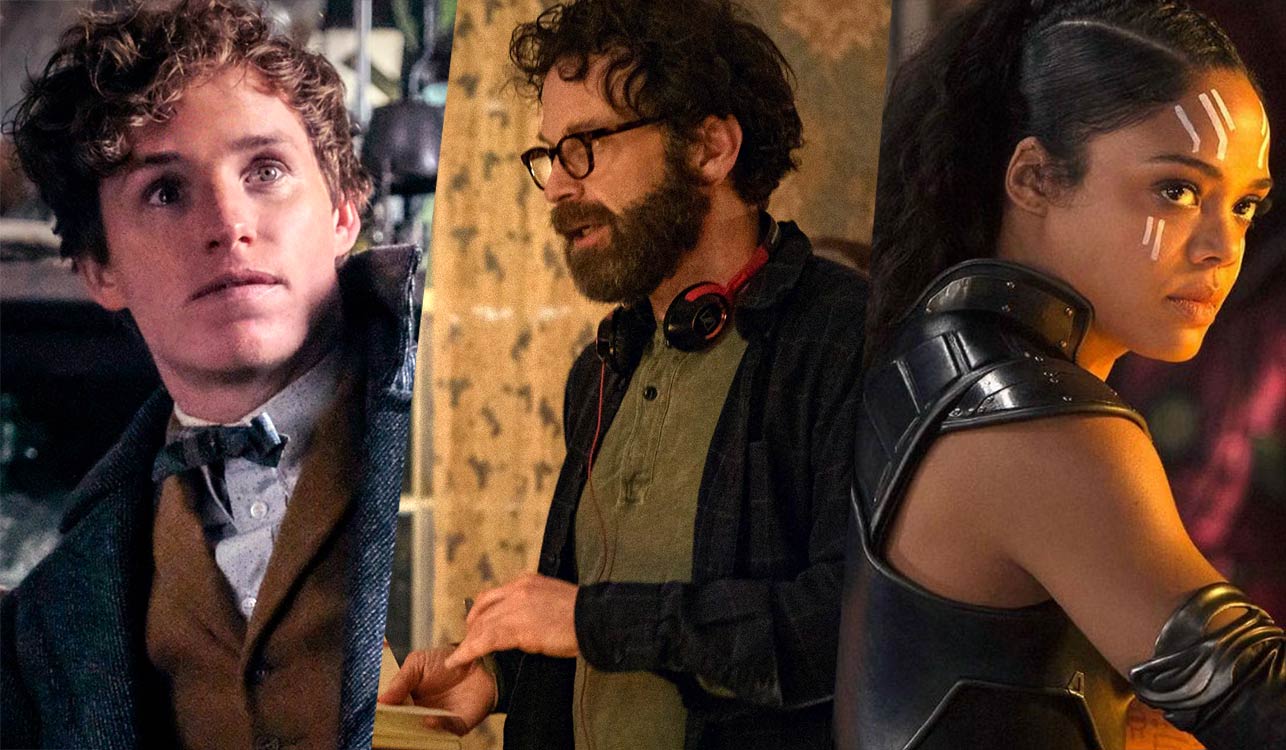
On a recent episode of Hollywood Reporter’s “It Happened in Hollywood” podcast, Charlie Kaufman gave his most revealing look yet at “Later the War,” the mysterious project that fell apart mid-production earlier this year. The filmmaker confirmed that the shoot had been planned for Serbia, not Poland, and that the project remains alive — at least in spirit. “We were not in Poland — it was in Serbia,” Kaufman said. “Belgrade was where we chose to do it, and we had some problems. We’re trying to regroup now, see if we can get it made, but it didn’t happen yet. It hasn’t happened yet.”
Before the production shut down, Eddie Redmayne was set to star, with Tessa Thompson among the ensemble, though Kaufman didn’t elaborate on their roles. Redmayne’s involvement tracks with Kaufman’s description of a performer-director character — someone navigating the space between comedy and credibility — while Thompson’s attachment suggested a dynamic that could expand the story’s emotional range. The collapse of the Belgrade shoot reportedly sent the project into limbo, though Kaufman’s phrasing (“trying to regroup”) implies a potential resurrection if financing can be reassembled.
Asked whether the story had to do with dreams or “dream manufacturing,” Kaufman replied, “I mean, ostensibly.” Then, with the classic Kaufman spiral, he began to unpack its layers: “There’s sort of a story within the story in the form of a film. The main character is a filmmaker. He’s very, very, very, very, very popular and very successful. And he’s also a physical comedian. And he stars in his films and he directs them, and he’s making an effort to be taken seriously.”
The host suggested that the setup sounded a little like Jim Carrey, but Kaufman immediately dismissed that comparison. “No, it’s not like Jim Carrey,” he said. “He’s not like Jim Carrey. I mean, first of all, he’s not a comedian like… I would say he’s more sort of like Buster Keaton in terms of the physicality of it. But also, Jim’s not a director. This guy’s a director, and he’s not based on any one person. I don’t think there is a person who fits that description.”
He admitted, though, that Carrey’s singularity helped him imagine the cinematic language of his protagonist’s work. “Certainly, I think about Jim when I think about physical comedy, and it’s been a big part of trying to sort of figure out what the look of this comedian’s work is, because I want it to be singular, and Jim is so extraordinarily singular in what he’s able to do,” Kaufman said. “But I didn’t want it to be like Jim Carrey. I wanted it to be more sort of Buster Keaton, I guess — more like a silent comedian.”
As he continued, the movie’s meta structure started to come into focus. “Within this sort of new iteration, he’s making serious movies,” Kaufman explained. “And there is one that you sort of see him making, and you see the movie throughout. You see a lot of his movies throughout the story, and it’s very fractured, and it is, in itself, very dreamlike. The whole movie is very dreamlike in the way it’s constructed.” He described that inner project as “a story about a dream factory that is the basis for a movie that he is making and starring in, if that makes any sense.”
That circular logic — a filmmaker making a film about making films, drifting between dreams, memory, and creative breakdown — sounds like classic Kaufman. The title, “Later the War,” came up almost casually. When the interviewer asked what it was called, Kaufman answered plainly: “Later the War.” The host wished him luck: “I certainly hope I get to see that film.” Kaufman smiled: “I hope so too. I would love to see it as well.”
For now, “Later the War” exists only in fragments and conversation — a half-finished dream trapped in development purgatory. Still, the way Kaufman talks about it — a “dream factory,” a fractured film-within-film, a Buster Keaton-style physical comedian chasing artistic credibility — suggests a project that feels like his entire career folded in on itself. If it ever finds its way out of Belgrade, it might also be his most brutally honest one yet: a Charlie Kaufman movie about the impossibility of making a Charlie Kaufman movie.

Rodrigo Perez is the founder and editor-in-chief of The Playlist, which he launched in 2008. He has worked in entertainment journalism since 2000, including at MTV, and has written for SPIN, IndieWire, Pitchfork, Complex, Magnet, and various music, film, and entertainment publications over the past two decades.
- Rodrigo Perez
- Rodrigo Perez
- Rodrigo Perez
- Rodrigo Perez
- Rodrigo Perez
- Rodrigo Perez
- Rodrigo Perez
- Rodrigo Perez
- Rodrigo Perez
- Rodrigo Perez

