


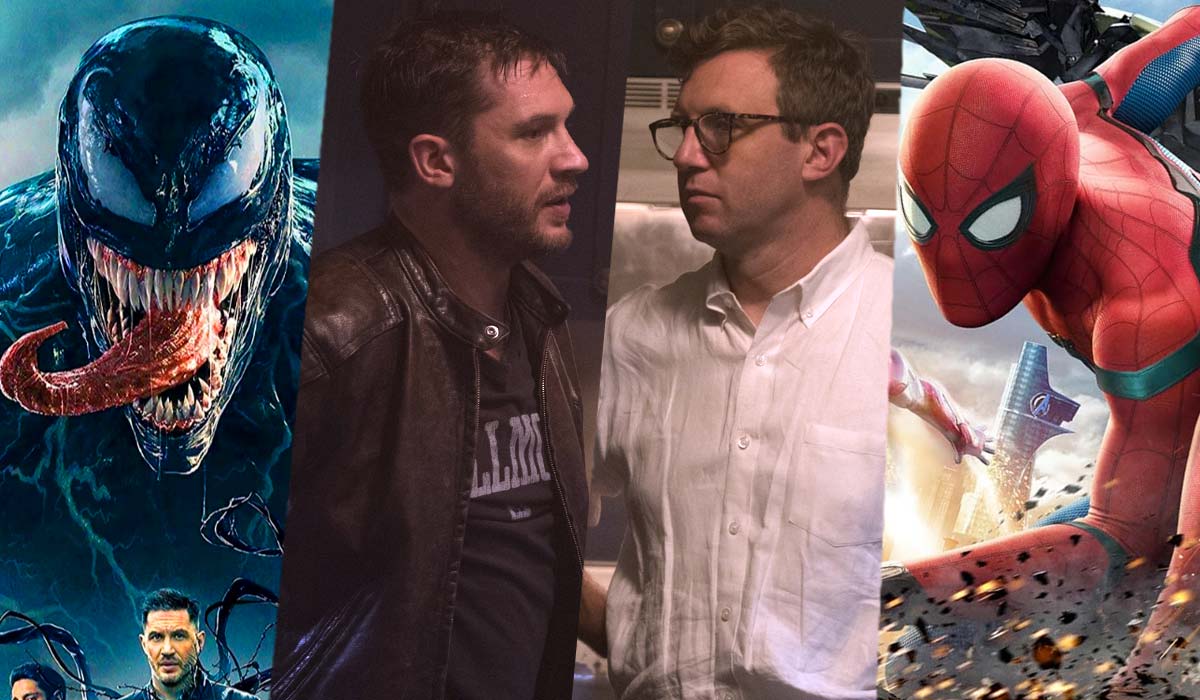
Ruben Fleischer has long balanced slick studio spectacle with his offbeat sense of humor, and few films illustrate that better than “Venom.” Reflecting on the 2018 Sony hit during a recent appearance on The Playlist’s Discourse Podcast, the director discussed the tonal tightrope of making the studio’s first Spider-Man–adjacent film — one that, by legal necessity, couldn’t feature the webslinger himself.
“I can’t really speak to too much because I haven’t seen all the other ones,” Fleischer said when asked why “Venom” connected with audiences while other Sony spinoffs, like “Morbius” or “Madame Web,” struggled. “But I think something that people love about ‘Venom’ is that he’s funny. You know what I mean? It doesn’t take itself too seriously. It’s kind of a ridiculous premise that you have an alien living inside you and sharing space with you.”
Fleischer took the absurdity and ran with it. “I kind of leaned into the—I don’t know if it’s really body horror—but ‘All of Me’ with Steve Martin was a big inspiration. ‘An American Werewolf in London’ was another one. Both are tonally on the more humorous side of things,” he explained. “I think ‘Venom’ is darker among the superhero franchises, just in terms of the way the character looks and his attitude. But he’s also really, really funny. So Tom Hardy was able to realize that wonderfully. And I think the charisma of Tom and of Venom himself is largely what has made it so popular among audiences.”
That mix of sincerity and absurdity extended to production. Asked about reports that Sony’s comic-book universe had too many executives influencing creative direction, Fleischer pushed back on the notion. “I’m really proud of the way that the movie turned out, and the process was a collaboration, like all studio movies are,” he said. “I think anyone who claims from any of the studios that they’re making $200 million movies and they’re singular voices is probably not totally accurate.”
While “Venom” launched Sony’s self-contained Marvel franchise, Fleischer noted the team had to invent a new mythology without Spider-Man as an anchor. “That was the first real Spider-Man-affiliated movie,” he said of his ‘Venom’ movie. “We were all trying to figure out exactly what that wants to be. ‘Venom’ was always defined by Spider-Man—our movie couldn’t feature Spider-Man. So it created an interesting challenge.”
Fleischer confirmed that the absence wasn’t a late-stage change but was built into the concept from the start. “From my memory of it, granted it was a while ago, but from my memory of it, it was always distinct from Spider-Man,” he said. “Maybe there was the possibility of them crossing paths down the road, but inherent to ours was that it couldn’t be defined by that.”
Even the design of “Venom” himself reflected that separation. “It’s funny because in the comics, ‘Venom’ has a spider on his chest, and that’s because he derives from Spider-Man,” Fleischer said. “We had to come up with a whole new origin story and actually create a different pattern on his chest, unique for the film, because it wouldn’t have made sense if he had a spider on his chest if he had no affiliation with Spider-Man.”
In hindsight, Fleischer seems content with where that path led. “Venom” became a $856 million global success, spawning two sequels and cementing Hardy’s version as one of the most idiosyncratic antiheroes in modern comic-book cinema. “It all worked out the way it was supposed to.”
More from our full Discourse interview with Ruben Fleischer — including updates on “Now You See Me: Now You Don’t,” “Uncharted 2,” and his Western-vampire film “The Sun Always Sets in the West” — coming soon. — Additional reporting by Mike DeAngelo.

