


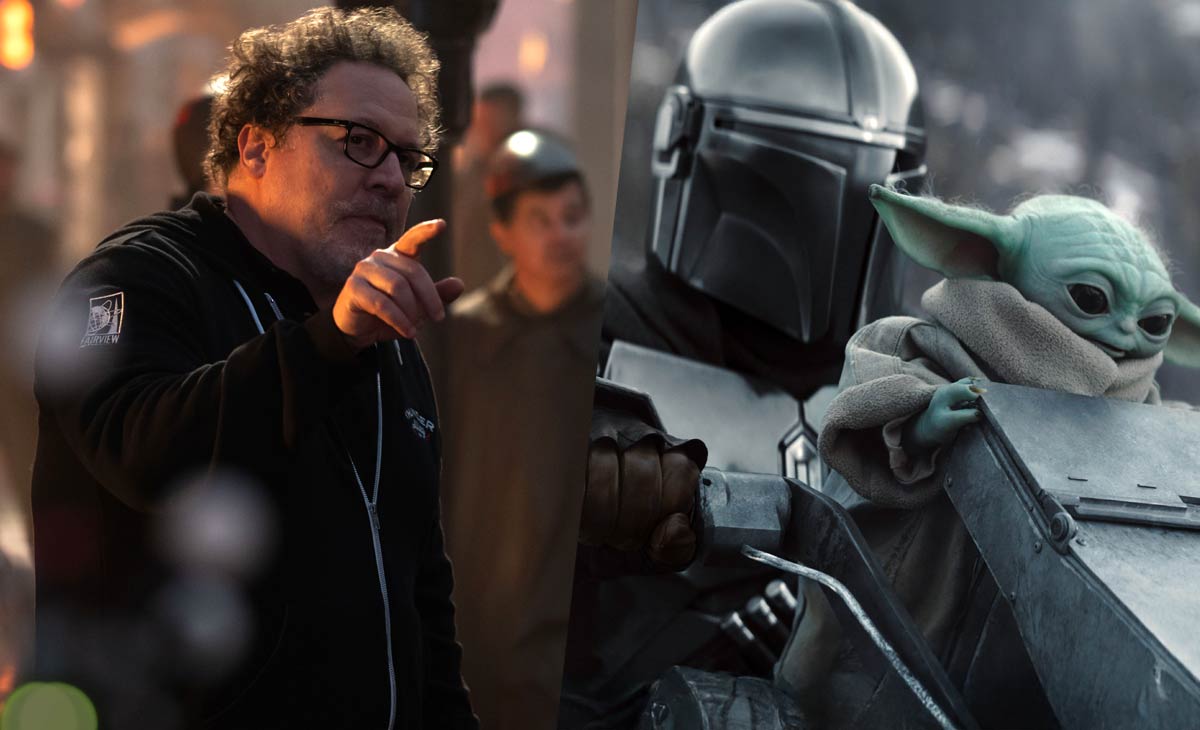
For all the continuity, canon, and fan expectation that now comes baked into “Star Wars,” Jon Favreau said the next theatrical chapter with his “The Mandalorian & Grogu” film has to begin with a much simpler challenge: make it work for people who have never seen one of these movies on the big screen.
Speaking on Puck’s “The Town” podcast during CinemaCon this week, Favreau said moving from the streaming language of “The Mandalorian” into a theatrical feature forced a creative reset. Instead of assuming viewers had kept up with every chapter and every season, he said he had to approach the film more like “season one, episode one”—an entry point rather than a continuation built only for the initiated.
“You gotta deliver something that the audience enjoys regardless of the medium,” he explained. “We have to treat it like the first season and the first episode of ‘The Mandalorian, ‘which is don’t assume anybody’s seen anything, but also make it clear to the people who’ve been with ‘Star Wars’ for 50 years that this is something that is for them.”
That reset, in his telling, is partly generational. “Star Wars hasn’t been in theaters for almost seven years,” Favreau stressed. “There are audience members who were not old enough to know ‘Star Wars’ in the theater. We have to invite those fans in. We have to make them feel the way that I felt when I first saw ‘Star Wars.’” He tied that directly to the kind of sensation the franchise can still deliver when it lands at full scale. “There’s a feeling that ‘Star Wars’ gives you on the big screen when it’s done well,” he said. “And that’s what we concentrated on, really delivering that feeling.”
What that means creatively is a push back toward the franchise’s pulp DNA. Favreau said the film version leans into the older currents that inspired and shaped George Lucas in the first place.
“We really lean into that kind of pulpy, fun space opera thing,” he said, before getting more specific about the lineage. “He originally was exploring getting the rights to ‘Flash Gordon’ before Star Wars. ‘Flash Gordon’ is a much different format. It’s big, it’s fun, it’s fantasy, it’s pulp.” Favreau said that the epic size of it all is part of the point now. “These are scale set pieces that work for the big screen in a way that they wouldn’t for the small screen. And so we started leaning into the roots of sci-fi space opera like Flash Gordon and like what inspired Star Wars and the filmmakers of that generation.”
Favreau was more careful when the conversation turned to AI. He did not talk like a filmmaker rushing to hand the keys over to a new toy. Instead, he sounded like someone trying to slow the conversation down and separate one tool from another. “We need to have better conversations around AI because there’s a lot of confusion about what the term even means,” he said. “I do think that we need to have clarity about what’s the spectrum of these machine learning tools.” He also drew a line at what he is doing himself right now: “For what I’m doing now, I have not used that.”
What interested him more was the overlap between filmmaking and game-engine tech, especially in planning and pre-production. Favreau said those tools can tighten the process before a shoot ever starts and make a production more precise by the time cameras roll. That is where he sees a real shift happening—less as some abstract AI revolution than as a practical reworking of how movies get built, staged, and budgeted.
But the bigger point kept circling back to theaters. Favreau said part of the appeal here is getting another shot at the collective response that made “Star Wars” feel huge in the first place. “I remember the feeling of a whole crowd reacting to a ‘Star Wars’ movie when it’s done well,” he said, “and the chance for me to take a swing at doing that and feeling the energy in the room.” Whether that becomes a longer-term theatrical cadence for Lucasfilm is still an open question, and Favreau did not bite on anything beyond the movie in front of him. For now, his emphasis was simpler than that: make the next “Star Wars” movie feel alive enough that new audiences want in, and old ones remember why they showed up in the first place.
“The Mandalorian & Grogu” opens May 22, 2026. Watch the full conversation below.

Edward Davis is a senior film journalist and longtime contributor to The Playlist. Davis covers the full breadth of cinema — from major studio releases to independent and international film.


