



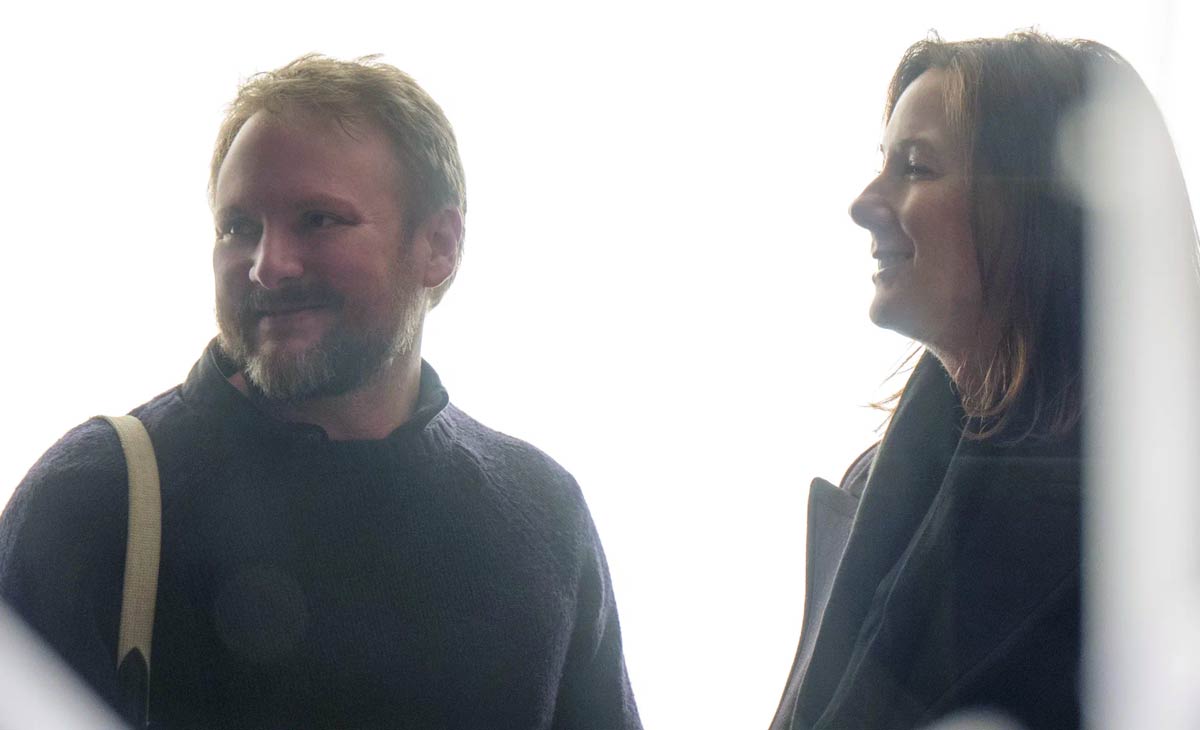
Filmmaker Rian Johnson has a concise response to the idea that the ugliest corner of the “Star Wars” internet scared him off a galaxy far, far away. “Lol, zero spooked, sorry,” he wrote on Twitter late this week.
That’s the director’s public rebuttal after former Lucasfilm President Kathleen Kennedy suggested—during her exit-interview media run—that the director ultimately backed away from his long-rumored, long-vanished “Star Wars” trilogy in part because of the online dogpile that greeted “Star Wars: The Last Jedi.”
The comment created quite the stir online—Kennedy’s belief that a filmmaker who took a big swing on the franchise “got spooked by the online negativity.” And now Johnson is swatting that away in public, in real time, brushing it off his shoulder as it were.
Still, the obvious follow-up—and the one fans will keep circling— is the same one that’s lingered since 2017: if he wasn’t chased off, or “spooked,” what actually happened?
Because the opportunity was real—at least on paper. Back in November 2017, Lucasfilm announced that Johnson would create a “brand-new” trilogy, with Johnson set to write and direct the first film and longtime producing partner Ram Bergman to produce. And yet, eight-plus years later, there’s been no title, no casting, no release date—nothing that suggests the thing ever moved from the “we should do this” stage into a real, on-the-books production.
Johnson’s own explanation, in earlier interviews, has consistently been less about fan fury and more about inertia and timing. He’s said, “Nothing really happened” with the trilogy beyond kicking around ideas, and that once “Knives Out” took off, he “was off to the races, busy making murder mysteries.” That version of events doesn’t require anyone to be “spooked”—just the familiar Hollywood reality that development is a limbo-state, and even a marquee announcement can remain conceptual if nobody forces it into the next phase.
And, to be fair, the “busy” part is not hand-waving. Netflix famously paid an eye-watering sum for the rights to two sequels, pulling Johnson into a multi-year commitment as writer-director (and, per his own comments elsewhere, the only person steering that franchise). With “Wake Up Dead Man: A Knives Out Mystery” now out in the world (after a theatrical window and a Netflix debut), the immediate Blanc sprint has, at minimum, hit a natural pause point—the exact kind of moment that invites the “so… ‘Star Wars’ now?” question.
But “not spooked” doesn’t automatically translate to “available,” let alone “happening.” Even Johnson’s door-left-open quotes come attached to a condition: it must “make sense” for both sides, and he’s also been candid that he’s happy doing his own work right now. That’s the less dramatic, more plausible explanation: after getting handed the keys to a mega-franchise and living through what that spotlight does to a movie (and the people around it), maybe the appeal isn’t fear—it’s autonomy. Writing a wholly original murder mystery every few years, on your own terms, is its own kind of power move.
There’s also the franchise-side reality, which has been messy for years: “Star Wars” theatrical plans have repeatedly shifted, with various films announced, retooled, delayed, or quietly shelved. That instability is part of the backdrop here—especially as Kennedy steps away and new leadership takes over, with Dave Filoni and Lynwen Brennan moving into the top roles. If the next regime wants a clean slate, Johnson’s trilogy could be either a tempting “prestige filmmaker returns” headline or a complicated relic from the previous era.
So what does Johnson’s tweet actually change?
It doesn’t resurrect a trilogy, which he said is “effectively dead.” It doesn’t provide a new reason. What it does is narrow the narrative: he’s rejecting the idea that backlash frightened him into retreat. And if you take him at his word, the remaining explanations aren’t mysterious at all—just unsexy: the trilogy never advanced beyond early conceptual talk, he got locked into Netflix’s Benoit Blanc machine, and Disney’s “Star Wars” film strategy kept evolving around him rather than with him.
The fan’s itch for a single, satisfying answer may never be scratched because the likely truth is plural: momentum died, priorities shifted, and the franchise didn’t meet him at the exact moment he was ready. Johnson can be “zero spooked,” and the trilogy can still be functionally dead—at least until someone, someday, decides it’s worth turning those old conversations into an actual movie.
Filoni-Gate Quashed Before It Begins
And, while we’re here, another small “Star Wars” dust-up also got immediately walked back this week. The Wrap published a Kennedy-era retrospective that claimed—via an unnamed person “who worked inside Lucasfilm”—that the company’s newly installed top creative executive, Dave Filoni, disliked “Andor.”
But that same Wrap piece also amended itself a few hours later, reporting that a Lucasfilm spokesperson denied the claim as inaccurate—another reminder that, in this franchise, the discourse can turn a single anonymous assertion into a weekend-long proxy war before anyone pauses to ask what’s actually on the record.
The mini-firestorm made a certain kind of sense on social media, since Filoni’s “Ahsoka”/“The Mandalorian” brand of serialized mythology-building doesn’t really resemble Tony Gilroy’s thornier, ground-level “Andor” lane—and the series has become a weirdly loaded Rorschach test inside the fandom precisely because it’s been critically acclaimed (and awards-friendly) while also turning off some corners of the base for being too grim and “not Star Wars” enough. But between Lucasfilm moving quickly to deny it and fans immediately resurfacing old clips of Filoni praising the show, the whole thing felt like a reminder that “Star Wars” is whatever the creatives decide it is in a given moment—and if recent chatter about a “Star Wars” horror project is any indication (revealed by Tony Gilroy, no less), the sandbox is only getting broader, not narrower.

