



For Christopher Nolan, “The Odyssey” did not begin as a post- “Oppenheimer” victory lap; instead, it started with a striking image of a sinking horse.
In a new TIME profile, Nolan traced the origin of his long-developing Homer adaptation back over 20 years, to an earlier moment when he was in talks to direct 2004’s “Troy.” That film, based on “The Iliad,” ultimately went to Wolfgang Petersen, but Nolan never let go of one image: the Trojan Horse, half-submerged in water, looking like a gift already being reclaimed by the sea. The idea, as Nolan described it, was that the Trojans would not see a military trick. They would see a strange prize they had to rescue before the tide pulled it away.
“If the horse were sinking into the sand and about to be swept away by the tide, the Trojans would never believe there could be anybody in there,” Nolan said. “They would be rescuing this thing from the waves and dragging it into the city as a prize. It wouldn’t be on wheels, like a roller skate.”
That image is classic Nolan: a mythic object turned into a logistical trap, an ancient story reframed through engineering, timing, panic, and human bodies under pressure.
In 2023, “Oppenheimer” became the kind of phenomenon Hollywood rarely produces anymore: a three-hour, R-rated historical drama about J. Robert Oppenheimer that grossed nearly $1 billion worldwide and won seven Oscars, including Best Picture and Best Director. For Nolan, that success opened the door to something even older, stranger, and riskier.
“That gave me options,” Nolan said. “And what had never really been done is a cinematic telling of ‘The Odyssey’ with all of the capacity of a large-scale Hollywood studio production. It’s an odd gap in movie history.”
READ MORE: 27 Most Anticipated Films From The 2026 Cannes Film Festival
It’s a fair point. Homer’s “The Odyssey” has shaped centuries of storytelling, and cinema has borrowed from it endlessly; the long journey home, etc. But Nolan is arguing for the full theatrical version. That means no easy green-screen shortcut. Nolan’s reputation for practical filmmaking has become part of his brand, but he pushed back on the idea that he is hostile to digital tools.
“I’ve developed a reputation for not liking visual effects. But, you know, my films have won three Oscars for visual effects,” Nolan said, with a laugh. “I know a lot about it, and I’m really fascinated by it. But I like to make films with a very grounded tone.”
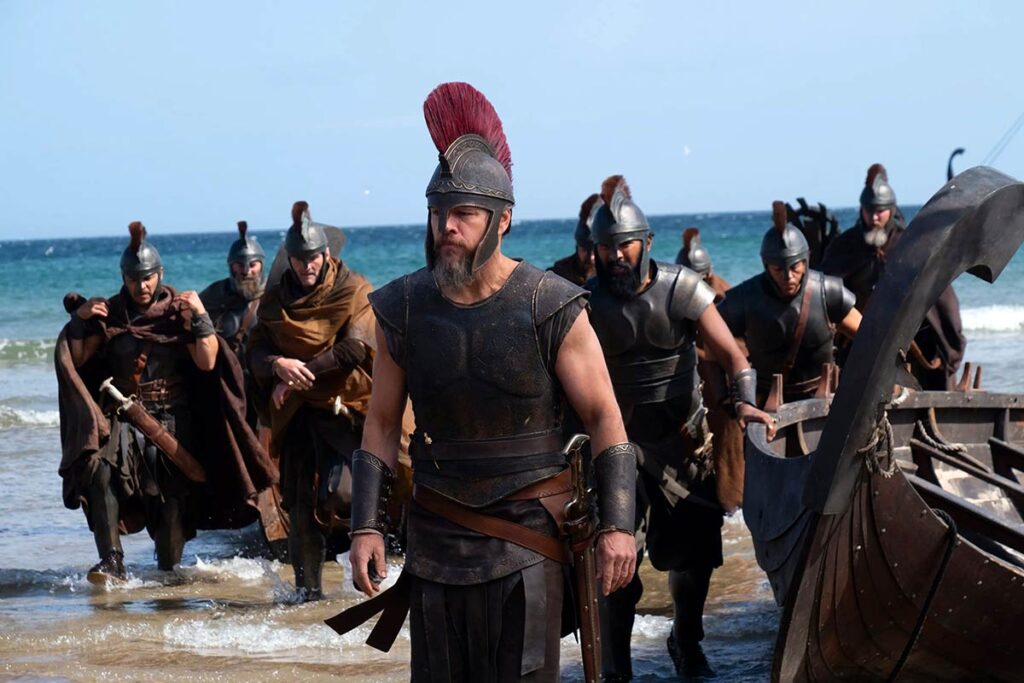
That grounded tone is the key to his “Odyssey.” The film follows Odysseus, played by Matt Damon, on his 10-year journey home after the Trojan War, encountering the Cyclops, sirens, sea monsters, Circe, and Poseidon’s wrath. But Nolan’s interest seems to be in making myth feel tactile rather than decorative. The gods may be everywhere, but the danger has to register as weather, water, exhaustion, and human choice.
That practical approach also extends to how Nolan thinks about the ancient world itself. For “Interstellar,” he leaned on scientific speculation to imagine the future. For “The Odyssey,” he used a similar logic in reverse, trying to imagine the past with as much rigor as possible.
“For ‘Interstellar,’ you’re looking at, ‘What is the best speculation of the future?’ When you’re looking at the ancient past, it’s actually the same thing. ‘What is the best speculation and how can I use that to create a world?’” Nolan said. “Hopefully they’ll enjoy the film, even if they don’t agree with everything. We had a lot of scientists complain about ‘Interstellar.’ But you don’t want people to think that you took it on frivolously.”
“The Odyssey” gives him a story about a brilliant man trying to get home, but also one whose cleverness, pride, and appetite for survival make him difficult to reduce to a conventional hero. Nolan is aware that some of those themes echo across his own filmography, and he doesn’t sound especially troubled by that.
“You have to be comfortable with repeating yourself, if it’s right for the project,” Nolan said. “If you’re paying too much attention to what people are pointing out in your work, you’d be paralyzed.”
Meanwhile, the scale matters. Damon, who plays Odysseus, described the film as the kind of old-school epic Hollywood rarely attempts anymore.
“Movies like this are not getting made anymore. To do this without a green screen, the way that David Lean would have done it, I don’t know anybody, with the exception of Chris, who’s even trying to do that,” Damon said. “There aren’t a lot of people in their mid-50s as protagonists in these epics. I looked at this like the last movie I’d ever do.”
At a time when studios are careful, franchises are unstable, and theatrical moviegoing remains under pressure, he is one of the few directors who can walk into a room and pitch Homer as an IMAX event.
Even then, Nolan’s longtime producer Emma Thomas said the filmmaker still takes studio notes seriously, not as interference but as a necessary creative pressure.
“I think the day we don’t take notes anymore is the day we make a crappy movie,” Thomas said. “There is the creative benefit of having people question you and to really make you justify what it is you’re doing. We also want the studio to be invested in our movie. They have to sell it.”
Thomas also noted that Nolan remains unusually disciplined on set, finishing “The Odyssey” in 91 days, nine days ahead of schedule.
“He’s kind of a machine when it comes to shooting,” Thomas said. “It’s very funny: when he’s writing, we’ll go for a hike, and he’ll say, ‘Stop going so fast.’ The minute we start shooting, his heartbeat speeds up. He’s suddenly a different person completely. He just moves fast.”
That speed doesn’t appear to have translated into comfort. Anne Hathaway, who plays Penelope, said the production’s austerity was part of the point.
“They save the money for the screen,” Hathaway said. “You’ve got Tom Holland, Robert Pattinson, a slew of other very fine actors, me, and we’re all staying in budget accommodation on a small island in Sicily because there’s no indulgent nonsense. It’s just about the work, and we’re all so happy to be there.”
That might be the clearest description of Nolan’s current power: not luxury, but permission. After “Oppenheimer,” he could have made almost anything. He chose a story older than cinema itself, an image he had been holding onto for two decades. “The Odyssey” is Nolan returning to the sea with the backing to make Homer feel epic again.
“The Odyssey” opens in theaters on July 17.