


History buffs never hunger for World War II content since year after year a previously unexplored crevice of the conflict or a new angle on a well-known event is explored on screens big and small. That turns the task of making an original WWII movie into a considerable challenge. And while “Pressure,” the latest from Australian director Anthony Maras adapted from David Haig’s 2014 stage play, isn’t exactly a revolutionary piece of cinema, it benefits from the containment that it likely borrows from its source material.
READ MORE: 53 Must-See Films To Watch Summer 2026
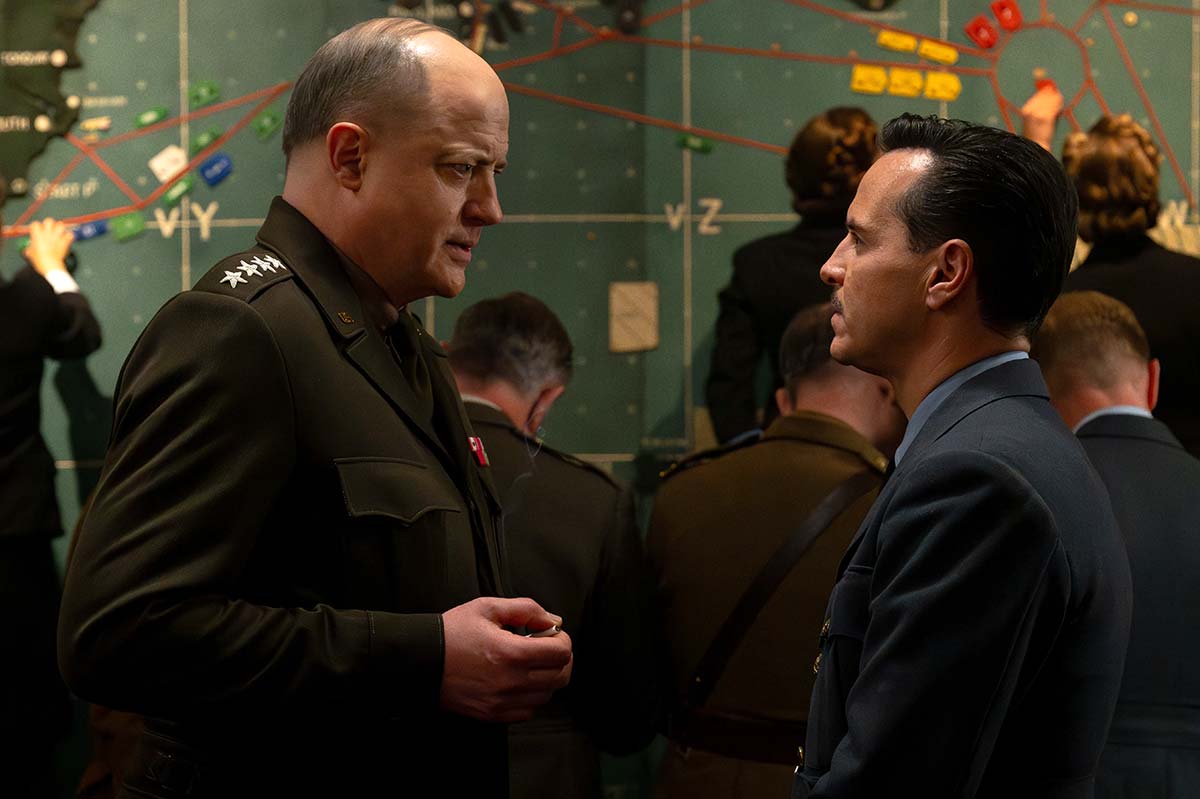
With 72 hours before D-Day in June 1944, Group Captain James Stagg (Andrew Scott), a renowned British meteorologist, is called in to help General Dwight ‘Ike’ Eisenhower (Brendan Fraser) determine if the weather will be favorable when the Allied troops storm Normandy. The extent of what’s revealed about the perpetually serious Stagg is that he’s left behind his pregnant wife. But, mostly to the benefit of the picture, no flashbacks to his childhood or to any other period prior to this moment appear. That in turn means all that’s known as far as motivations and personality will come from these immensely tense few days. Thankfully, Scott is a gifted actor who can conjure up an inner world even from the minimal exposition at hand. Scott’s Stagg knows what’s on the line and acts accordingly.
The majority of “Pressure” unfolds inside crowded halls where men, with the exception of Eisenhower’s most trusted secretary Kay Summersby (Kerry Condon), gather to help other men make decisions that will affect countless military and civilian lives. For all the high stakes arguments that comprise the story, Maras’ direction is no more than perfectly competent in crafting a conventionally rendered piece that leans into formal tropes, like montages of men intensely working on charts to the tune of a stirring score. Sequences that drop us into the carnage of the disastrous Exercise Tiger, a D-Day rehearsal gone wrong, and eventually into the action of the actual Normandy landings, allow Maras to briefly step out of the confines of the project’s inherent theatricality for more muscular filmmaking (bloodied waters, corpse-ridden beaches, and the thunderous sounds of heavy artillery).
As Stagg begins to doubt June 5 is the ideal day for the operation, his American counterpart, Irving Krick (Chris Messina as comic relief), later described as ”a confident moron,” maintains that conditions on the same date in years past point to clear skies. The clash between the two, with Stagg undermining Krick and threatening his position with Eisenhower, represents the core of the drama. Everyone wants for Krick’s forecast to be true, but Stagg holds evidence implying that’s not the case. The notion of certainty haunts everyone involved. Eisenhower and the generals demand it. Stagg can’t assure it. And Krick is desperate to provide it no matter the cost. But weather doesn’t function in absolutes, and that’s the crux of war in general: the consequences of uncontrollable variables. Instead of pushing those ideas into a more thoughtful exploration, Maras, perhaps staying faithful to Haig’s work, marches on to the triumphant pathos expected from most movies of “Pressure’s” ilk.
Believable if not surprising, Fraser has gotten sweaty exasperation down to a science since his lauded comeback in “The Whale,” and brings it to the foreground here as Eisenhower at his own darkest hour. When the barometric pressure decreases, the one of his character’s blood rises. It’s a showier performance than any other in Maras’ picture, but understandably so. Condon’s warmth and levelheadedness brings a counterweight to the testosterone-driven interactions, which makes one wonder if a movie about Kay Summersby could offer a distinct perspective on the battle games that men play.
A late scene sees Stagg receive a call with potentially horrific news just as Eisenhower berates him about his position on weather will behave on the fateful Monday. Scott’s visage drips with distress, and yet the utterly professional character must maintain his composure in front of his superior at such critical time. That combination of forces pulling at Stagg makes for a charged scene that Scott commands with the restraint of a performer versed in complicated headspaces. Moments like this, or when Stagg witnesses his expert predictions manifest in the real world, present the conditions for “Pressure” to amount to something more. It doesn’t, but it’s still a vehicle for Scott to reinforce his impressive versatility.
“Pressure” moves along with enough of a hook to keep one invested, despite its predetermined conclusion and overly familiar structure. As far as paying respect to the unsung heroes that meteorologists were in the war effort, the film carries out its duty. In terms for bringing the winds of change to the subgenre of WWII films, the result is more static than airborne. [C]


